For most Amazon sellers, FBA shipping costs can take up 15–25% of their product cost. When people think about “cutting costs,” the first idea is often to switch to slower boats or cheaper carriers. But that frequently leads to delayed restocks, inventory running out, or even extra FBA inbound defects fees.
Lower cost does not have to mean slower speed. The real solution is to reduce your per-kg or per-cbm shipping cost systematically — without hurting supply chain stability or speed — through smarter shipment planning and the right logistics partner.

Why Cutting Costs Often Slows Down Your Supply Chain
Many sellers try to save money by moving from two sailings per week to one, or by breaking full containers into LCL and waiting for other orders to fill up. Those moves seem to lower the cost per shipment, but they often bring three typical warning signs of a slowing supply chain:
| Warning Sign | What It Looks Like | Impact on Inventory |
|---|---|---|
| Long waiting time to gather cargo | Waiting 2–3 weeks at a warehouse to fill one container | Longer replenishment cycle, stockouts on best sellers |
| More than 3 transshipments | Factory → local warehouse →Transit Warehouse → Hong Kong → FBA | 1–2 days stop at each handoff, total time up by 5–7 days |
| Unstable sailing schedules | Carrier changes routes often, ETA keeps moving | Hard to plan restocks, have to keep extra safety stock |
So the real challenge is: cut costs without adding waiting time, without adding extra transshipments, and without losing ETA reliability.
Method 1 – Optimize Shipment Frequency & Container Utilization
Many small to mid-sized sellers ship whenever they get orders — sometimes just a few dozen kg at a time. That’s flexible, but the cost per kg is very high. On the other hand, combining shipments smartly lowers your per-kg cost without slowing things down — as long as the consolidation itself doesn’t create extra waiting time.
Here’s how you can do it:
-
Use your last 4 weeks of sales data to find the minimum economic shipment volume for each SKU (for example, at least 2 cbm or half a small container).
-
Set up a fixed weekly shipping plan with your forwarder (e.g., cargo cut on Wednesday, sail on Friday), instead of waiting until everything is ready.
-
Know the tipping point between LCL and FCL: when your volume exceeds 15 cbm, a full container often costs less than LCL — and you skip one extra warehouse handling step.
At AMZ SHIPPER, our personalized service team helps sellers calculate the right shipment volume for each SKU and create “mixed loading plans” — different SKUs or even different sellers’ goods go into the same container but separated by zones. You get FCL pricing without extra waiting time.
Method 2 – Choose a Partner with Strong Local Advantage in China
The biggest variable in FBA head haul cost is often not the ocean freight — it’s the local pickup, consolidation, and customs clearance in China. If your forwarder doesn’t have its own warehouses or long-term partner warehouses in China, every shipment may bring extra drayage, storage, and handling fees.
Three real cost advantages from a China-based warehouse network:
-
Lower drayage cost – Warehouses are close to factory clusters (Shenzhen, Guangzhou, Yiwu, Xiamen, etc.), pickup within 2 hours, so you pay less for short-haul trucking.
-
Higher consolidation efficiency – Multiple sellers’ cargo can be prepped, palletized, and labeled inside the same warehouse, no need for a second transshipment.
-
Stable, compliant customs clearance – Experienced with China export rebates and FBA requirements, so you avoid container holds or customs delays due to paperwork issues.
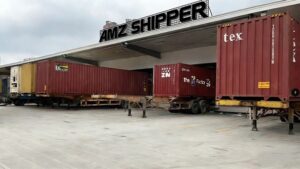
AMZ SHIPPER has owned and partner warehouses in South and East China, covering major manufacturing regions. Goods can go directly from factories to these warehouses, get prepped the same day, and catch the nearest sailing. This saves 1–2 days compared to traditional models and cuts handling cost per cbm by about 18%.
Method 3 – Build a “Flexible Transit Time” Supply Chain
Not every product needs the fastest shipping. A mature supply chain strategy is to match different SKUs with different transit time & cost options — not a one-size-fits-all approach.
You can group your products like this:
-
Top sellers (70% of revenue) – Keep a fast lane: use expedited ocean or economy air, so the total time from shipment to FBA receiving stays under 18 days.
-
Regular movers – Use stable but slower ocean services (like Matson extra-loader or CMA EXX), plan for 30–35 days total, and restock two batches ahead.
-
Bulky / slow-turn items – Use the most economical general cargo ships, restock every 60 days, but only choose carriers with on-time reliability above 90%.
The key point: slow does not mean unreliable. A slower ocean service with a schedule reliability over 90% is actually more predictable than a faster service that keeps changing dates. You just set your order trigger date based on its fixed ETA — no stockout risk.
AMZ SHIPPER’s “flexible transit time” solution provides each client with historical on-time performance and extreme delay probability for every sailing, so you can make data-driven choices.
Method 4 – Use Your Forwarder’s Volume to Lower Your Per-Kg Cost
Small and mid-sized sellers rarely get competitive rates directly from ocean carriers, because they don’t move 500 TEU per year. But when you ship through a forwarder that handles thousands of TEUs annually, you can share that volume advantage immediately.
Three direct benefits from economies of scale:
-
Get the same contract rates as big shippers — 20–35% lower than spot market prices.
-
Priority space allocation — less risk of being rolled even during peak season.
-
Longer free detention & demurrage (from 7 days to 14 days), so you avoid late fees.
AMZ SHIPPER moves thousands of containers every year and has long-term contracts with multiple major carriers. Your cargo goes into those same big boxes — no extra waiting, because the space is already secured, and the containers load directly from our partner warehouses. This is the real reason why “lower cost” does not mean “slower.”
Checklist – Is Your Current Shipping Plan Slowing Down Your Supply Chain?
Go through these three warning signs to see if your current FBA inbound logistics has hidden slowdowns:
-
Warning 1: More than 7 days from factory pickup to vessel departure
That usually means consolidation or front-end handling is stuck. Check if you’re waiting too long to fill a container, or if the warehouse is slow. -
Warning 2: Cargo is transshipped 2+ times before the main ocean leg
Example: Factory → Warehouse A → Warehouse B → Terminal. Each extra handoff adds about 2 days of stop time and higher damage risk. -
Warning 3: Your carrier cannot provide on-time records for the last 6 months
Without data, you cannot make reliable restock plans. Ask for proof of at least 90% schedule reliability for the route they offer.
If you answer “yes” to any of the above, then even if the freight rate looks cheap, your total supply chain cost (including stockout losses) is actually higher.

7. Why AMZ SHIPPER Can Deliver Low Cost + Fast Chain at the Same Time
AMZ SHIPPER’s entire service model is built around the idea of “cost reduction without slowing down the supply chain.” Our four core strengths directly support the methods we talked about above:
-
Competitive prices – From thousands of containers per year, we share carrier contract rates with you. We also reduce wasted space through mixed container loading.
-
Efficient logistics – Our China warehouse network handles same-day receiving and prep. Fixed weekly sailings with ETA deviation under 3 days.
-
Reliable partners – We only work with routes that have historical on-time performance above 88%, and provide full chain transit reports for every shipment.
-
Personalized service – We calculate the “economic shipment quantity” and “transit time flexibility index” for each seller, then give specific advice on consolidation and sailing choices.
ABout AMZ Shipper
AMZ Shipper has several years of experience for international logistics Freight Forwarding service. Our service is for importer and exporter, foreign freight forwarders, local and abroad business. Export of 1500 of 40HQ per year for FBA Amazon shipping, 15-30tons of air shipments per month.
Member of WCA. Our company is a professional Amazon freight forwarder that specializes in providing comprehensive and efficient services to customers.