Amazon FBA first-leg logistics has a tricky feature that gives sellers a real headache: almost every forwarder looks the same when they send you a quote. Everyone claims they have “direct carrier space,” “stable transit times,” and “compliant customs clearance.” But once your goods are on the vessel, there is not much you can do. By the time you find out the container got rolled, customs held it up, or Amazon rejected the shipment, the loss has already happened.
So the real problem is not “which one to choose” — it is “how to verify.” You don’t need to become a logistics expert, but you do need to know what to ask, what data to look at, and what documents to check before you sign anything. Here is a verification framework built around four dimensions.
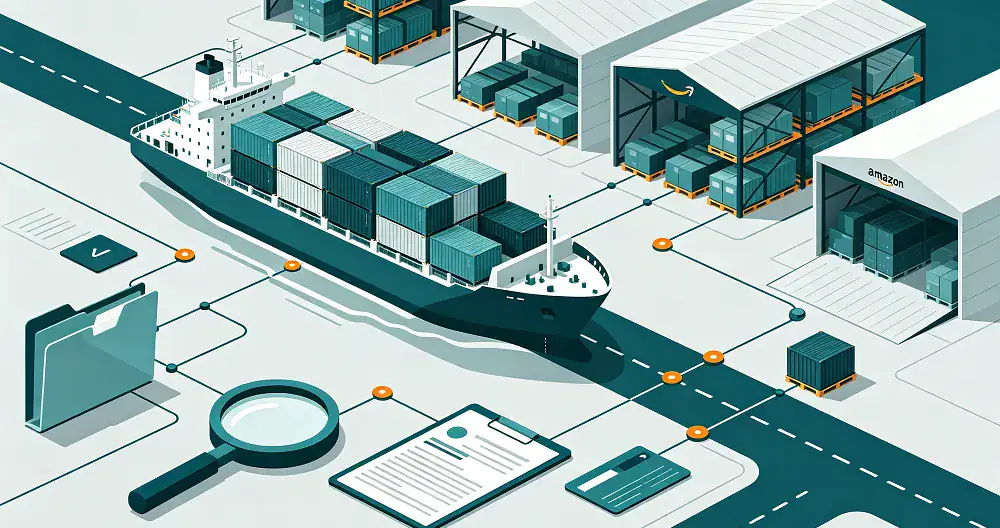
Dimension One: Company Identity — Who Are You Actually Dealing With?
The forwarding industry has a structural feature: a large number of small and mid-sized forwarders are actually playing the role of “an agent’s agent.” They get space from a bigger first-hand operator and resell it to sellers. This is not illegal by itself, but the problem is that when something goes wrong, your cargo may be stuck in a chain of multiple layers, and holding someone accountable becomes very difficult.
The first thing to verify is who the company you are facing actually is.
Consistency between business registration and operating address is a starting point, but it is not enough on its own. Many forwarders are registered in one city while their actual warehouse is in another. This is not necessarily a red flag, but it needs to be questioned: is the warehouse self-operated or partnered? If partnered, what are the qualifications of the partner? You can cross-check registration information through Qichacha or Tianyancha, but what matters more is asking for real video footage or a live location of the warehouse, not just looking at promotional photos.
On the ocean freight side, if a forwarder claims to be an NVOCC (Non-Vessel Operating Common Carrier), you can verify their status and compliance record through the U.S. Federal Maritime Commission’s public database. The FMC’s OTI list shows compliant ocean transportation intermediaries, including licensed holders and foreign-registered NVOCCs. A trap to watch for: some forwarders are not NVOCCs themselves but simply have a partnership with a licensed one. This does not automatically mean they are unreliable, but it does mean the entity issuing the bill of lading may not be the company you signed with — and the legal path to pursue a claim changes if something goes wrong.
Air freight qualifications work in a similar way. If the other party claims to hold IATA credentials, ask for the certificate number. But more often, the forwarder is not an IATA-accredited agent itself but works with one. This also needs to be clarified: who actually receives the cargo? Whose name is on the air waybill as the shipper?

Dimension Two: Space Source — Not “Do You Have Space,” but “How Did You Get It”
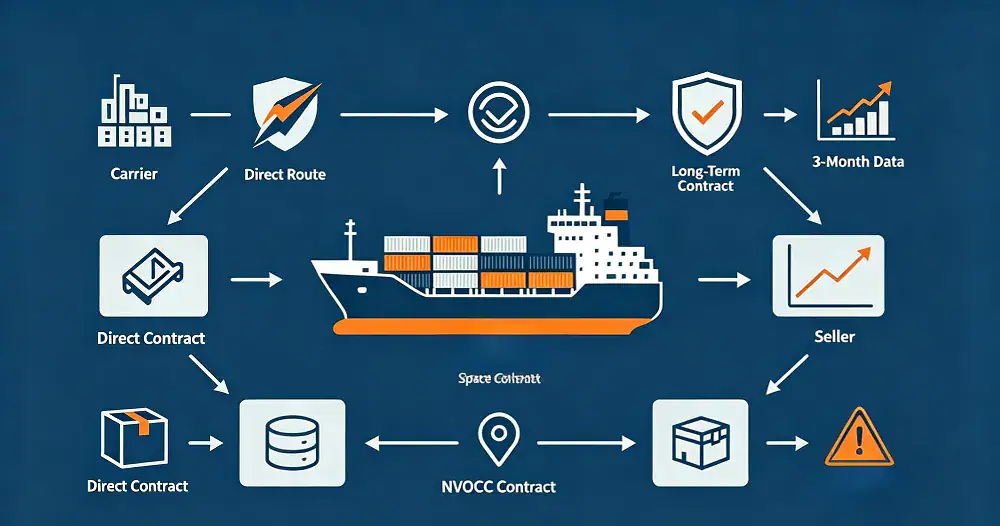
“First-hand space” is one of the most abused phrases in the forwarding industry. The reality is that even first-hand operators may face space adjustments from the carrier during peak season. The key is not what they claim, but whether they can answer specific questions.
You can ask a simple test question: “Is your Matson or ZIM space from a direct contract, or do you get it from another operator?” A vague answer (“we have long-term cooperation,” “we have stable channels”) is a failed verification. An acceptable answer should include the specific structure: are they directly contracted with the carrier, or do they have a long-term contract with a licensed NVOCC? Does the contract cover peak season?
Roll-over rate data is another verifiable entry point. Ask for roll-over data on the same route for the past three months. If the forwarder cannot provide any specific data and just repeats “we are very stable,” that itself is information. A forwarder with real operational capability should be able to track whether their customers’ containers got rolled and accumulate historical data. A “small batch test” before peak season is a practical verification method: ship a small batch of high-turnover goods and see whether your container gets priority handling when space is tight.
Dimension Three: Penetrating Verification of Customs Clearance Capability
Starting January 1, 2026, Amazon has ended its internal FBA prep and labeling service. All shipments must complete Amazon-compliant prep before arriving at fulfillment centers. This means a forwarder’s prep capability has shifted from a “bonus” to a “must” — but it also makes verification more important, because inbound defect fees from prep errors have risen sharply. A rejected shipment can wipe out the profit of an entire container.
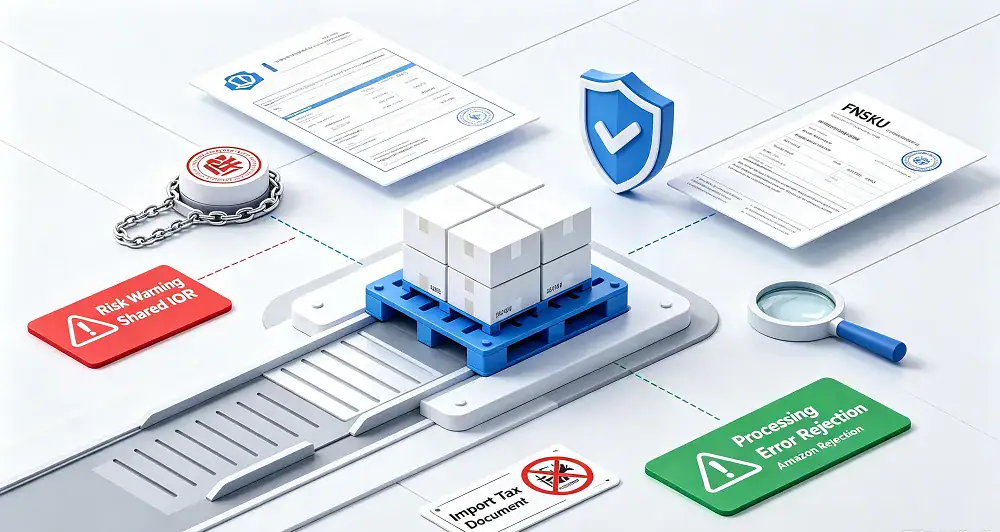
IOR (Importer of Record) ownership is the core of customs verification. A compliant DDP channel should use a genuinely registered IOR, not a shared shell entity. The risk of a shared IOR is that if one shipper violates rules, every shipper under that same IOR gets pulled into the mess, facing elevated inspection levels or even cargo detention. The verification method is to ask directly: “Whose name is the IOR registered under? Can you provide the registration record?”
Tax payment documents are another key verification point. A compliant channel can produce the destination port’s import tax documents, while under-declared or gray channels usually cannot. If the other party refuses to provide any tax calculation explanation on the grounds of “all-inclusive tax,” that itself is a signal.
Verification of prep capability should not stop at verbal promises. You can ask for recent FNSKU labeling error rate data. If this data exists, it shows the other party has a quality tracking mechanism. If they say “we have never made a mistake,” that is actually a suspicious answer — a “zero error” claim without data support is not verifiable.
Dimension Four: Auditability of the Quote Structure
Low-price quotes are a customer acquisition tactic, but the gap between “low price” and “total cost” often only shows up during peak season or customs inspection.
The key to verifying a quote is asking for a breakdown: base ocean freight, fuel surcharge, peak season surcharge, customs declaration fee, palletizing and labeling fee, inspection handling fee — listed item by item. An “all-inclusive price” sounds convenient, but it makes it impossible to judge which costs have been squeezed and which risks have been hidden.
Fee cap clauses are a more practical verification tool. Ask a specific question: “Is there a cap on inspection fees? If so, what is it, and can it be written into the contract?” A quote without a cap clause means inspection costs are fully exposed. Port demurrage and amendment fees are also worth asking about — who bears them, and under what rules?
The table below organizes the core verification questions and warning signs across the four dimensions. You can use it as a checklist when talking to forwarders.

Verification Checklist: Asking the Right Questions Matters More Than Listening to Promises
| Verification Dimension | Core Questions | Warning Signs |
|---|---|---|
| Company qualifications | Is the NVOCC license verifiable on the FMC public database? Who issues the bill of lading? | Refuses to provide license number; company name differs from contract entity |
| Space source | Direct contract or resold? Roll-over rate data for the past three months? | Vague answers; cannot provide any historical data |
| Customs compliance | Whose name is the IOR registered under? Can you provide a sample tax document? | Refuses to explain IOR ownership; cannot provide tax payment proof |
| Prep capability | FNSKU labeling error rate data? Is there a cap on inspection fees? | Claims “zero errors” but has no data; quote is not itemized and has no cap |
The value of this checklist is that it turns verification from a subjective judgment into an objective comparison. You don’t need to judge whether the other person sounds confident — you just need to see whether they can answer specific questions and provide verifiable documents.
Take our own operating process as an example. When a new client asks about our space source, we provide a clear explanation of the specific cooperation structure. When a client asks about inspection fee caps, we write the cap into the contract. We do this not to look “better” than others, but because transparency itself is verifiable — and unverifiable promises mean nothing in the logistics industry.
The Purpose of Verification Is Not to Find the “Best” Forwarder
The ultimate goal of verification is not to find a flawless forwarder — perfection does not exist in logistics. Peak season delays, schedule changes, and customs spot checks are risks that cannot be completely eliminated. The goal of verification is to let you know what risks you are taking on, and who bears them.
A forwarder that stands up to verification will tell you before you sign which steps might go wrong and what the handling process is when they do. A forwarder that does not stand up to verification tends to spend its energy convincing you that “there won’t be any problems.”
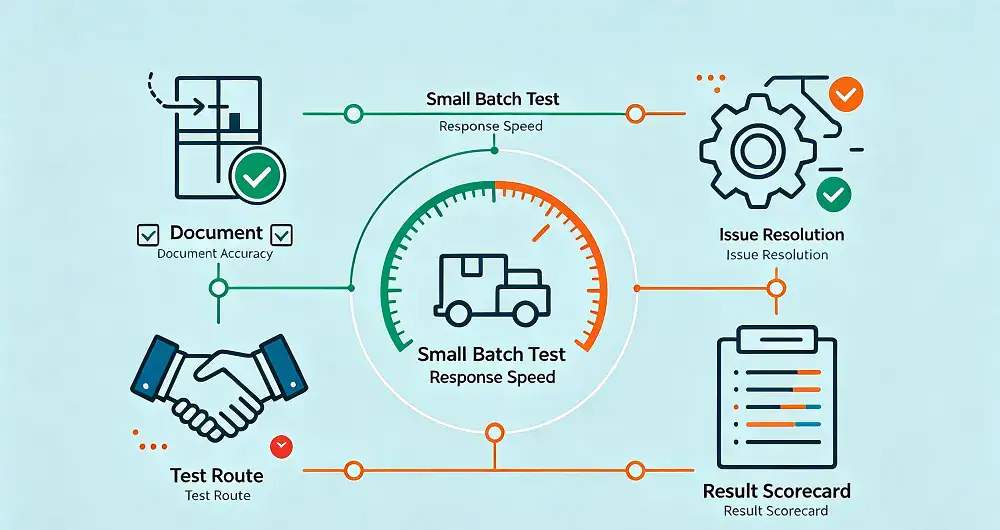
Start with a small batch test. Don’t use your most important peak season inventory for verification — use a shipment with moderate value and ordinary goods. Watch how quickly they communicate, how accurately they prepare documents, and how fast they solve problems when small issues come up. These signals say more about whether a forwarder is worth a long-term partnership than any promotional material.
ABout AMZ Shipper
AMZ Shipper has several years of experience for international logistics Freight Forwarding service. Our service is for importer and exporter, foreign freight forwarders, local and abroad business. Export of 1500 of 40HQ per year for FBA Amazon shipping, 15-30 tons of air shipments per month.
Member of WCA. Our company is a professional Amazon freight forwarder that specializes in providing comprehensive and efficient services to customers.