2026 is a turning point for Amazon sellers. Amazon has completely ended its FBA prep and labeling service, which had been around for over a decade. All shipments now have to be packed, sealed, and labeled properly before they ever reach a fulfillment center. At the same time, the rules for inbound defect fees have gotten stricter. Label mistakes, sending goods to the wrong warehouse, late delivery — all of these can trigger charges. And if your defect rate keeps climbing, you may even face an account audit.

What this means is that a freight forwarder is no longer just a contractor that moves goods from point A to point B. How well they handle your shipment directly decides whether it gets into the warehouse smoothly — and whether you end up paying extra costs without even realizing it. A forwarder with sloppy operations might save you a little on shipping, but you could lose far more on defect fees, return shipping, and stockouts.
Here are ten red flags worth looking at carefully when you’re choosing an FBA freight forwarder in China.
Red Flag 1: Prices way below market average, with no breakdown of costs
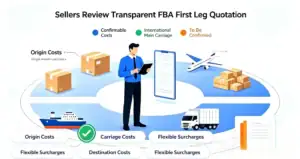
When you get a quote that’s much lower than everyone else’s, the thing to worry about isn’t “what a deal” — it’s what’s been left out. A common trick in the industry is to quote a bare-bones price to get you to place an order, then add on pickup fees, customs clearance fees, fuel surcharges, destination charges, appointment fees, and so on. The final bill can end up way higher than you expected.
What’s even more worth watching out for is unclear volumetric weight conversion. Different forwarders use different conversion factors. The same box can be billed at noticeably different weights depending on which factor is used. If the other side dodges this question during the quoting stage, disputes later on are almost unavoidable.
A reliable sign is when the forwarder proactively gives you a full cost breakdown, clearly states the volumetric weight conversion standard, and puts the logic for surcharges into the quote.

Red Flag 2: No FBA prep capability, or treating it as an “extra service”
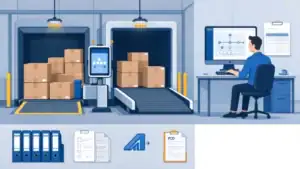
Now that Amazon has scrapped its official prep service, whether a forwarder can do FNSKU labeling, outer box compliance checks, poly bagging, or bubble wrap packaging has become a core capability, not a value-added extra.
Labeling problems account for a pretty big share of FBA inbound rejections. FNSKU labels that are blurry, wrinkled, or placed in the wrong spot — or that get mixed up with the product’s original barcode — can lead to direct rejection at the warehouse. Outer boxes without a “Made in China” mark, sealed with colored tape, or showing signs of damage or deformation will also get rejected.
If a forwarder seems indifferent to these issues, or says “labeling is your job, we just ship,” you need to seriously think about whether they’re the right long-term partner.
Red Flag 3: Slow communication, no proactive updates
The real quality of a freight forwarder shows up after the goods leave. A forwarder that responds quickly during pickup might become hard to reach once the shipment is on the water. Constantly changing contact persons, replying “it’s on the sea” when you ask about the vessel schedule, not pushing out ETA updates — these things usually point to loose internal management or the shipment being subcontracted to a third party.
Industry observations suggest that many small and mid-sized forwarders don’t have their own trunk lines or overseas teams. They’re basically just matchmakers, reselling cargo space. Pickup, trunk line, customs clearance, and last-mile delivery are handled by different teams. When something goes wrong, each party blames the other, and the seller can only wait.

Red Flag 4: Can’t explain who’s responsible for ISF filing and customs compliance
The accuracy and timeliness of ISF filing directly affects whether goods can enter the country smoothly. If a forwarder is vague about “who handles ISF filing,” “how HS codes are classified,” or “what the declared value is based on,” that’s a compliance signal worth paying attention to.
Customs clearance qualifications are another thing to watch. Some low-cost channels use shared tax IDs or under-declare to avoid tariffs. If customs catches on, goods can be detained — and it could even drag your store into risk control. Asking a forwarder to clearly explain their clearance method, tax ID usage, and compliant declaration process is a basic step in screening partners.
Red Flag 5: No flexibility for “non-standard situations”
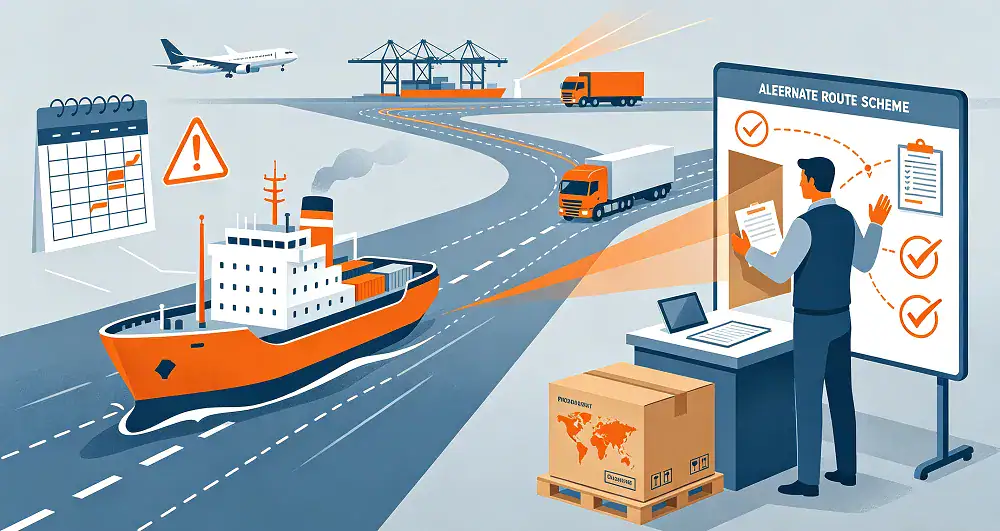
A forwarder’s real ability only shows when things go wrong. Try testing their response with a specific scenario: if the factory delays delivery and the original vessel can’t be caught, can they rebook in time? If the destination port is congested, is there an alternative routing plan?
A forwarder that only gives mechanical quotes and can’t offer real advice on specific operational scenarios will be helpless during peak season or emergencies. A partner worth trusting should be able to propose contingency plans before problems even happen.
Red Flag 6: No origin compliance check before shipping
In the 2026 FBA inbound rules, origin information entry has become mandatory. Missing or incorrect info will directly block shipment creation, and goods already sent out may be stopped by customs.
A responsible forwarder should remind you and help check whether origin markings are compliant and label info is complete before you ship. If the other side has no awareness of this at all, it means their operations are still stuck at the “just look at volume and weight” stage — hard to adapt to today’s compliance requirements.
Red Flag 7: Pushing a single shipping method, no combined options
A forwarder that only pushes air freight or only pushes ocean freight either has limited route resources or is using information asymmetry to make more profit. A reasonable first-leg strategy often needs to combine ocean, air, and express based on cargo value, timing requirements, and inventory rhythm.
A forwarder that can offer multimodal options and give advice based on your inventory plan is worth far more than a channel that just quotes a single price.
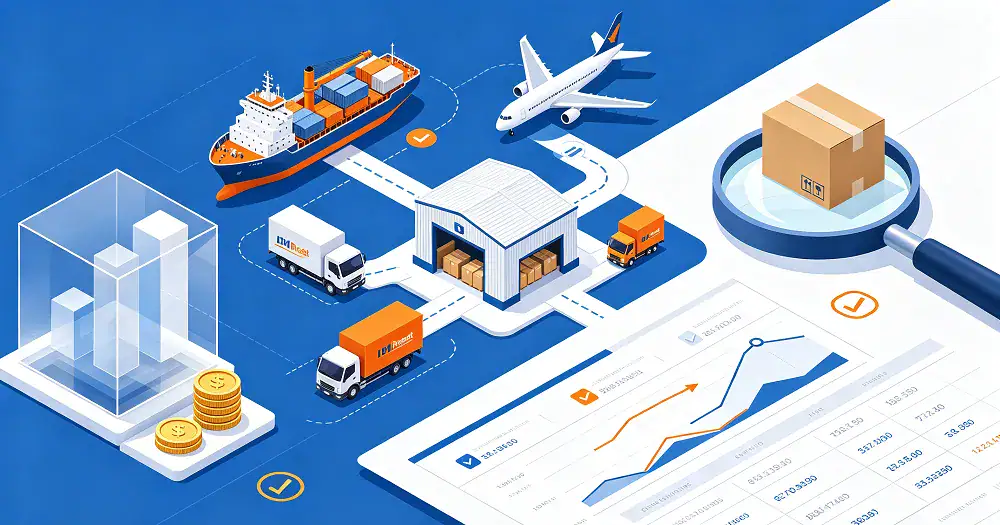
Red Flag 8: Lots of hidden fees, refuses to itemize
The key to telling “legitimate surcharges” from “hidden fees” is whether the cost can be explained and verified in advance. Fuel surcharges and port congestion fees are standard floating costs in the industry. But vague items like “handling fee,” “document fee,” or “service adjustment fee” often lack a transparent calculation basis.
A trustworthy approach: the forwarder provides a cost breakdown confirmation before cooperation, clearly stating the trigger conditions and calculation method for each fee. If the other side refuses with “it’s industry practice,” that’s a warning sign at the trust level.
Red Flag 9: Vague insurance options, unclear claims process
For high-value FBA cargo, insurance is the last line of defense if something gets lost in transit. But not all insurance pays out based on cargo value. Some logistics insurance uses a “pay by weight” model, with a fixed payout per kilogram that has nothing to do with the actual value of the goods.
Before cooperating, ask clearly: does the insurance pay based on declared value? What documents are needed for a claim? What’s the average processing time? If the forwarder doesn’t have clear answers, or suggests “no need to buy insurance,” you need to assess your own risk exposure.

Red Flag 10: No peak season capacity guarantee or policy adaptation advice
A forwarder’s value isn’t just in daily shipping — it’s also in whether they can guarantee capacity when peak season gets tight, and whether they respond quickly to platform policy changes.
In 2026, Amazon adjusted its billing rules across multiple dimensions, including inbound placement fees, defect fees, and aged inventory surcharges. A qualified forwarder should be able to advise on how these changes affect your shipping strategy — for example, how to avoid split-reason placement fees from mixed SKUs, or how to plan shipping rhythm to avoid late inbound penalties.
If the other side only cares about “how much for this shipment” and not about “whether your goods can get into the warehouse smoothly,” then they’re just a transport vendor, not a supply chain partner.
To make things clearer, here’s a comparison of three core dimensions when screening forwarders: “pre-compliance capability,” “cost transparency,” and “exception response.”
| Evaluation Dimension | Trustworthy Signal | Warning Signal |
|---|---|---|
| Pre-compliance capability | Proactively offers pre-shipment compliance checks, including label scannability, outer box markings, and origin info verification | Treats prep as an “extra service,” lacks basic awareness of 2026 rules |
| Cost transparency | Provides an itemized cost confirmation, clearly states volumetric weight conversion and surcharge triggers | Quote is far below market average, uses “all-in price” to dodge questions about cost structure |
| Exception response mechanism | Has a clear point-of-contact system, proactively pushes shipment milestone updates, has contingency plans | Communication drops after goods leave port, frequent change of contacts, no proactive updates |
Choosing an FBA freight forwarder is really about assessing whether a partner can help you share the increasingly complex inbound compliance risks of 2026. Price is one dimension, but it shouldn’t be the only one. A forwarder that’s slightly more competitive on price but operates cleanly and communicates transparently is often worth far more in the long run than a channel that quotes rock-bottom prices but runs a rough operation.
ABout AMZ Shipper
AMZ Shipper has several years of experience for international logistics Freight Forwarding service. Our service is for importer and exporter, foreign freight forwarders, local and abroad business. Export of 1500 of 40HQ per year for FBA Amazon shipping, 15-30 tons of air shipments per month.
Member of WCA. Our company is a professional Amazon freight forwarder that specializes in providing comprehensive and efficient services to customers.