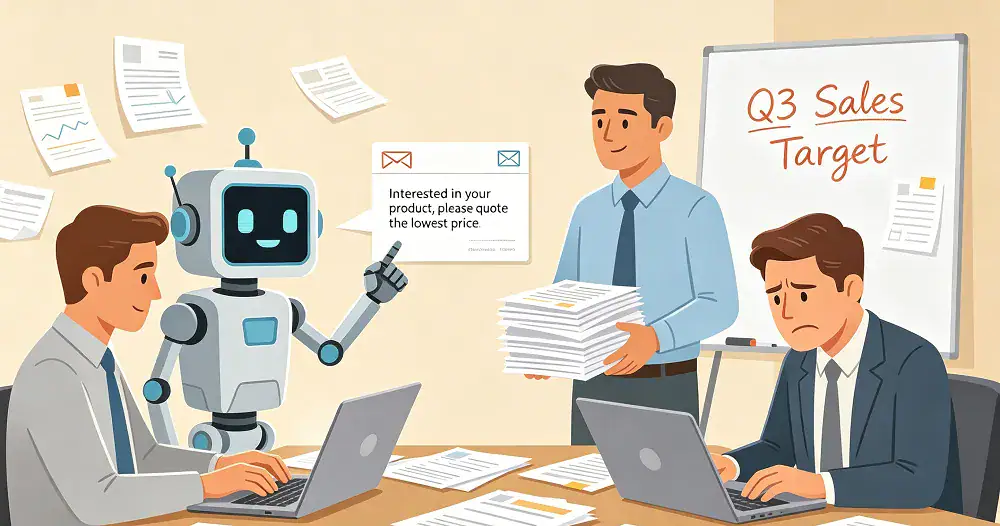
You run the marketing team for a cross-border seller. Today, your website gets an inquiry. Someone claiming to be a small wholesaler in the US wants to buy your main product. They include quantity, target price, even packaging details. Your sales person spends time working up a quote and sends a proforma invoice. And then – nothing.

This isn’t a one-off. In 2026, fake inquiries generated by AI are flooding cross-border B2B channels. They look real, but they’re actually batch‑produced by bots. The goals vary: testing email addresses, collecting pricing data, filling up competitor databases, or simply draining sellers’ sales resources.
According to cybersecurity reports, bot‑driven referral traffic has grown by 1615%. Cross‑border e‑commerce websites and B2B platform messaging are prime targets.
This article won’t talk about big AI trends. Instead, it gives you a practical method to filter fake inquiries and free up your sales team’s time.
1. Why Are Sellers and Factories a Main Target?
The people behind fake traffic don’t pick targets at random. Cross‑border B2B has several features that attract them:
High order value – A real B2B order brings good profit, so sellers are willing to put serious effort into following up on any inquiry that looks professional. Attackers know this. They can generate bulk fake inquiries at almost zero cost and effectively drain a competitor’s sales resources.
Many inquiry channels – Sellers get inquiries from website forms, Alibaba messages, social media DMs, WhatsApp, LinkedIn. Different channels mean inconsistent verification standards, which gives fake inquiries room to get through.
AI content is getting really convincing – Tools like ChatGPT can quickly generate inquiries that include product names, specs, quantities, packaging requirements, even industry terms. Glancing at one, it’s hard to tell fake from real.
Business intelligence value – A real inquiry tells you what products, what price range, what target market people are interested in. By sending bulk fake inquiries, attackers can trick sellers into replying with quotes and catalogs, cheaply collecting market data.

2. Typical Signs of AI‑Generated Fake Inquiries
Based on many real cases, fake inquiries usually show one or more of these signs. Keep this list handy for your sales team:
-
Suspicious contact info – The email is from a temporary domain (like
@temp-mail.org,@guerrillamail.com,@10minutemail.com) or just random numbers. The phone number’s area code doesn’t match the claimed location. -
Missing or conflicting company info – No company name is given, or the name turns up nothing on Google or LinkedIn. The claimed industry doesn’t match the product (for example, a construction materials company suddenly asking about consumer electronics).
-
Patterned inquiry content – The language is too smooth but lacks industry‑specific terms. It might copy product descriptions straight from your website. Inquiries from different IP addresses look very similar in format and wording.
-
Odd behavior on your site – Very short visit duration (submitting the inquiry within seconds). Abnormal click paths (landing directly on the inquiry page, no other browsing, no About Us or product pages). The IP is from a known data center or bot pool.
-
No response after follow‑up – No reply at all after you send a quote. An auto‑unsubscribe or “email doesn’t exist” bounce when you nudge. Refusal to share a business license or tax number when asked.

3. A Four‑Step Process to Filter Fake Inquiries
These four steps are ordered from lowest to highest effort. Build them into your sales SOP so you stop wasting time on dead‑end inquiries.
Step 1: At the very start – set up a basic gate
Add these low‑cost filters to your website form or B2B platform product pages. They block a lot of batch bot traffic at the source:
-
Turn on reCAPTCHA v3 or Cloudflare Turnstile. These are barely noticeable to real users but stop automated scripts.
-
Make certain fields required: full company name, company website, job title, tax number (or business registration number). Add a note next to the form: “Only real company inquiries accepted. Fake submissions will be logged and blocked.”
-
Optional: add a simple filter question like “What’s your approximate first order quantity range?” Bots usually don’t bother picking a real option from the dropdown.
Step 2: Before quoting – do a 5‑minute quick check
Before your sales person spends time working up a quote, run this cross‑check. It takes a few minutes but will filter out a lot of low‑quality leads.
| Check | How to do it | High‑risk signal |
|---|---|---|
| Company exists | Search “company name + LinkedIn” or “company name + website” | No record at all; only an empty shell site with no employee info |
| Email is real | Use Hunter, Snov.io, or Email Hippo | Email is from a temporary domain service; domain doesn’t match the claimed company |
| IP location | Use a free IP tool (like ipinfo.io) | City doesn’t match claimed location; IP belongs to a data center, not business broadband |
| Purchase logic makes sense | Does their industry match what they’re buying? | Completely unrelated (e.g., a scrap metal company asking about medical devices) |

Step 3: When quoting – add a low‑effort “test”
Even if the first two checks pass, you can add a small verification step during quoting. These “hooks” don’t offend real buyers, but fake inquiry senders usually ignore them or drop off.
-
Ask them to reply using their company email to confirm the delivery address, labeling requirements, or a delivery time window. Real buyers usually cooperate. Fake ones often stop here.
-
Offer a value‑add that’s only useful to real customers (like free custom samples or extra warranty). See if they show follow‑up interest in that specific offer.
-
Suggest a short video call (Zoom, Teams, or WeChat – 15 minutes max). Real buyers are often willing to hop on a quick call to check out a supplier. People behind fake traffic almost never show their face.

Step 4: During follow‑up – build an internal lead scorecard
Turn subjective judgment into objective scores. This helps your sales team stop agonizing over low‑quality leads.
Sample lead scorecard
| Scoring Item | Points | Why |
|---|---|---|
| Full company info provided (name, website, tax number) | +2 | More complete info = more credible |
| Uses company domain email | +3 | This is the single strongest trust signal |
| IP matches claimed location and is not a data center | +2 | Location makes sense and isn’t a server IP |
| Purchase logic matches their industry | +1 | Buying what you’d expect them to buy |
| Completed a video call | +5 | Almost certainly a real buyer |
| Asked follow‑up questions about delivery time, certifications, samples | +3 | Shows ongoing, specific interest |
How to use the scores:
-
Below 5 points: have an assistant or ops person reply with a standard template. Don’t use senior sales time.
-
5–8 points: normal follow‑up, standard process.
-
Above 8 points: prioritize deep engagement. Treat as a high‑potential lead.

ABout AMZ Shipper
AMZ Shipper has several years of experience for international logistics Freight Forwarding service. Our service is for importer and exporter, foreign freight forwarders, local and abroad business. Export of 1500 of 40HQ per year for FBA Amazon shipping, 15-30tons of air shipments per month.
Member of WCA. Our company is a professional Amazon freight forwarder that specializes in providing comprehensive and efficient services to customers.