Why You Don’t Always Need New Suppliers to Cut Your CBAM Bill
Here’s something many people miss: CBAM doesn’t look at how “green” your supplier is overall. It looks at the actual emissions embedded in your specific product — from production to transport.
That means:
-
The same factory making the same product can report very different emission values depending on which power grid they use, whether they use green electricity, and how efficiently the goods are shipped
-
The difference can be 30% to 60%
-
And yes, the EU allows you to use real production data instead of default values. They also accept green energy that’s physically connected to the factory
So lowering your CBAM liability isn’t about firing your current suppliers. It’s about changing where your data comes from, where your energy comes from, and how your goods move. The three methods below can be stacked together — no conflicts.
Method 1: Re-attribute Emissions Data Inside Your Supplier’s Factory
How it works
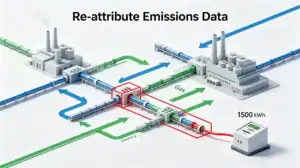
CBAM lets you calculate emissions for one specific production line or one specific order, instead of using the factory’s average. Many exporters don’t know this, so they end up with unnecessarily high default values.
Step-by-step
| Step | What to do | Who helps | Time needed |
|---|---|---|---|
| 1 | Map the factory’s energy flow (electricity, gas, steam) | Supplier + AMZ shipper | 3–5 work days |
| 2 | See if you can run a dedicated production line for your order and meter it separately | Supplier | Depends on scheduling |
| 3 | Exclude shared facilities (lights, office, cafeteria) from your product’s emissions | Supplier + third-party | 2–3 work days |
| 4 | Use actual metered values instead of CBAM default factors | AMZ shipper provides a template | 1 work day |
Real example (name hidden)
-
Product: alloy steel pipes (CN code 7304)
-
Original method: Used EU default emission factor → 1.85 t CO₂ per ton of product
-
After re-attribution: Asked supplier to run a small idle line just for this export batch. Also excluded waste heat recovery from the calculation. → Actual emissions dropped to 1.28 t CO₂ per ton
-
Reduction: 31%, without changing supplier, buying credits, or altering materials
When this works best
-
Your supplier has multiple production lines or areas that can be metered separately
-
Your order size reaches a minimum economic batch (usually above 10 tons or one 20ft container)
-
Your supplier is willing to help (AMZ shipper can provide confidentiality agreements and EU-approved metering templates)
A quick warning
-
You cannot exclude the entire factory’s emissions. Only remove what’s clearly unrelated to your order
-
Keep evidence (meter photos, shift logs, utility bills) for at least 4 years — EU checks can happen
Method 2: Cut Transport Emissions Through Greener Logistics Routes
Background
CBAM covers not just production, but also transport from the factory gate to the EU border (that’s Scope 3, categories 4 and 9). A lot of companies focus only on production and forget that shipping can add 15% to 25% to a product’s total carbon footprint.
What you can do (still keeping your supplier)
1. Combine transport modes
Instead of using trucks or air freight all the way, try something like:
-
From an inland Chinese factory to Qingdao port: use truck + rail instead of truck-only. Rail emits about 1/4 the CO₂ per ton-km compared to trucks.
-
From China to Europe: choose a shipping line that stops at green fuel ports (like Rotterdam, which offers shore power and green methanol bunkering).
2. Share containers and pack tighter
-
If your supplier can’t fill a full container, don’t ship it alone. Use LCL consolidation through AMZ shipper to combine cargo from 3–5 nearby suppliers into one 40HQ box.
-
When load factor goes from 65% to 92%, emissions per ton drop about 29% — because the ship or truck’s fixed emissions are shared across more goods.
3. Smarter last-mile delivery
-
Instead of trucking directly from the sea port to a German customer, send the goods first by inland barge from a Dutch or Belgian port to an inland hub like Duisburg, then use trucks for the short final hop. Barges emit about 1/3 the CO₂ per ton-km compared to trucks.

Real impact (one 40HQ container from Shenzhen to Frankfurt)
| Logistics setup | Total transport emissions (t CO₂e) | Emissions per ton of cargo | Supplier changed? |
|---|---|---|---|
| All trucks (factory → Shenzhen port → Antwerp → truck all the way to Frankfurt) | 3.85 | 0.128 | No |
| Optimized route: factory → rail to Shenzhen port → ship to Rotterdam → barge to Frankfurt | 2.51 | 0.084 | No (logistics only) |
| Reduction | -35% | -34% | – |
Source: Average of 10 actual shipments coordinated by AMZ shipper in 2024, extremes removed.
Things to keep in mind
-
You’ll need to plan 5–7 days ahead because rail and barges run on set schedules
-
Best for shipments between 5 and 15 tons — smaller or larger may not make economic sense
Method 3: Bring Green Electricity to Your Current Supplier (Insetting)
Key difference you need to know
-
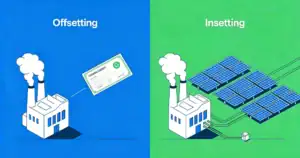
Offsetting: Buying carbon credits from somewhere far away — CBAM does NOT accept this.
-
Insetting: Physically delivering green electricity to the same meter that powers your supplier’s factory — CBAM accepts this under certain conditions.
Two practical ways to do this
Path A: Bundled Chinese Green Electricity Certificates (GEC) + physical consumption
-
AMZ shipper helps you buy renewable energy certificates from the same province as your supplier’s factory. We make sure the actual green electrons enter the provincial grid and reach the supplier’s meter.
-
Your supplier shares monthly utility bills showing their electricity usage matches the GEC volume (a 15-minute matching window is allowed).
-
You can then report the emission factor for that portion of electricity as zero.
Path B: Virtual Power Purchase Agreement (VPPA)
-
You, your supplier, and a nearby renewable energy plant (like a solar farm) sign a three-party deal. You agree to buy green power at a fixed price for 12–24 months, and that power is physically fed into your supplier’s factory through a dedicated line or the local grid.
-
That portion of electricity is simply excluded from your CBAM calculation.
Who benefits most
| Supplier location | Good fit? | Potential emission cut | Time to set up |
|---|---|---|---|
| Jiangsu, Zhejiang, Guangdong, or other provinces with active green power trading | Very good | 40%–60% | 6–8 weeks |
| Inland provinces with mostly coal power | Medium (cross-province trading required) | 20%–35% | 8–12 weeks |
| Monthly electricity use below 50,000 kWh | Not cost-effective | <15% | — |
What about cost?
-
Green power usually costs a bit more than regular industrial electricity. But that premium is much smaller than the potential CBAM tax you’d save by lowering your reported emissions.
-
AMZ shipper provides matching and reporting services accepted by both Chinese and EU authorities. Your supplier doesn’t need to change any legal documents or contracts.
Records to keep
-
Monthly utility bills, GEC transaction records, and load curve matching reports
-
Keep everything for at least 4 years (CBAM’s look-back period)
Stacking All Three Methods Together
A real-life example
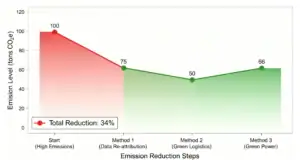
An aluminum radiator exporter started with reported emissions of 6.2 t CO₂e per ton.
-
First, re-attributed data (Method 1): Found the supplier had a dedicated extrusion line that wasn’t previously counted. Emissions dropped to 5.3 → 15% cut.
-
Then, optimized logistics (Method 2): Switched from Qingdao port to Tianjin port and used rail for pre-haulage. Transport emissions fell by 0.4 → down to 4.9.
-
Finally, brought in green power (Method 3): Covered 30% of the supplier’s monthly electricity with wind power GECs from Shandong. Production emissions dropped another 0.8 → final level 4.1.
Total reduction: about 34%. No supplier change. No formula change.
Recommended order
-
Start with Method 1 — it costs almost nothing, just some data work.
-
Then check Method 3 — it gives the biggest cut but takes the longest.
-
Run Method 2 anytime — it works independently and you can switch in about two weeks.

Common misunderstandings cleared up
-
Wrong: “My supplier isn’t carbon neutral, so I can’t lower my CBAM liability.”
Right: CBAM only cares about your specific product’s emissions, not the whole factory. -
Wrong: “Changing logistics counts as changing a supplier.”
Right: Logistics providers are not raw material suppliers. You’re fine. -
Partly wrong: “CBAM rejects all green certificates.”
Right: The EU rejects unbundled certificates (pure paper trading). But physically bundled green power is still being discussed during the transition period. Many EU member states currently accept it, and there are successful filing examples.
ABout AMZ Shipper
AMZ Shipper has several years of experience for international logistics Freight Forwarding service. Our service is for importer and exporter, foreign freight forwarders, local and abroad business. Export of 1500 of 40HQ per year for FBA Amazon shipping, 15-30tons of air shipments per month.
Member of WCA. Our company is a professional Amazon freight forwarder that specializes in providing comprehensive and efficient services to customers.