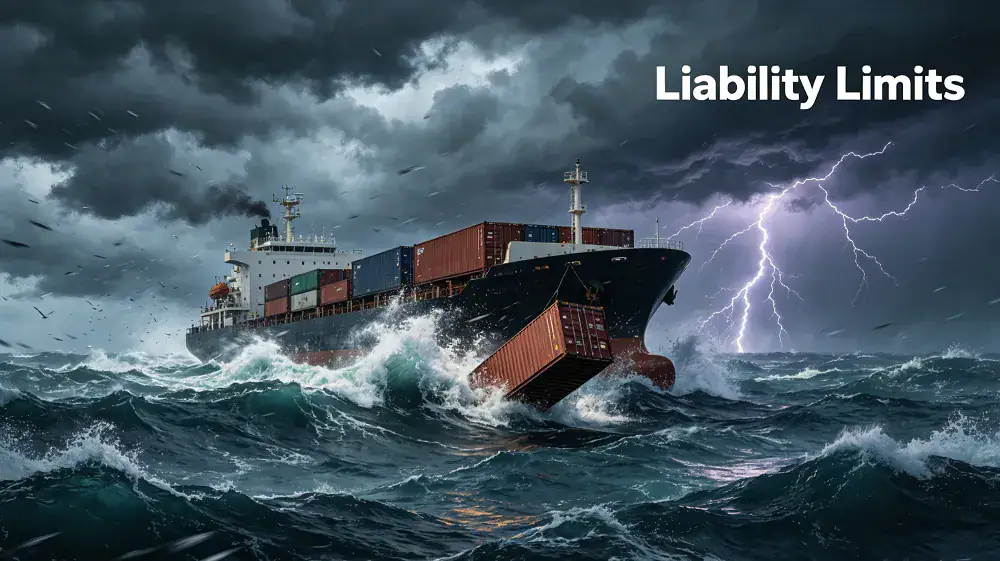
When a container goes overboard during sea freight, it’s a rare but painful event for cargo owners. The frustrating part? Even though you handed your goods to the carrier, you probably won’t get fully paid for what you lost. The answer lies in something called “cargo liability limits” —a legal concept accepted by international shipping conventions and pretty much every country’s maritime law. This article walks you through the legal basis, who is responsible, how the math works, and what you can actually do to protect yourself.
1. What Are Liability Limits? Why Carriers Are Allowed to Pay Less
Liability limits are exactly what they sound like—a legal ceiling that caps how much a carrier (the shipping line) has to pay when your cargo gets lost or damaged at sea. Instead of paying the full value of your goods, they only have to pay a certain amount per package or per kilogram.
This idea goes all the way back to the Hague Rules of 1924. Why? Because ocean shipping is risky—bad weather, rough seas, and other dangers are part of the job. If carriers could be forced to pay unlimited compensation, no one would want to run a shipping line. Insurance would become impossible, and global trade would grind to a halt. So the international community agreed on a trade-off: carriers get limited liability, and cargo owners buy their own insurance to cover the rest.
Here’s a quick look at the main international rules and how they compare:
| Convention / Law | Liability Limit | Where It Applies |
|---|---|---|
| Hague Rules (1924) | £100 per package or unit (old value) | Older bills of lading |
| Hague-Visby Rules (1968) | 666.67 SDR per package or 2 SDR per kg (whichever is higher) | Most major carriers today |
| Hamburg Rules (1978) | 835 SDR per package or 2.5 SDR per kg | Fewer countries, narrower use |
| Chinese Maritime Code (1993) | Same as Hague-Visby | Bills of lading issued at Chinese ports |
SDR (Special Drawing Right) is a kind of international currency unit created by the IMF. Its value changes daily based on a mix of five currencies: US dollar, euro, Chinese yuan, Japanese yen, and British pound.
As the table shows, different rules give you different limits. The key point is that no matter how valuable your cargo really is, the carrier’s legal obligation is capped at a relatively low level.

2. So Who Actually Pays When a Container Goes Overboard?
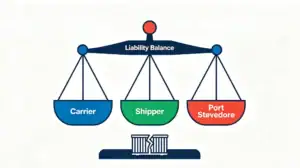
It depends on what caused the accident. The responsibility isn’t always on the shipping line. Let’s break it down.
The Carrier (Shipping Line or Subcontractor)
-
Navigation or management mistakes – If the container fell because the crew made an error, the ship rolled heavily in a storm, or lashings came loose due to rough seas, the carrier can usually claim the liability limit. You get the capped amount, not your cargo’s real value.
-
Unseaworthiness – If the ship itself had a problem (like broken lashing gear, leaky hatch covers, or a cracked hull) and the carrier didn’t check it before sailing, they may lose the right to limit liability and have to pay what your goods were actually worth.
-
Intentional misconduct – This is rare. But if you can prove the carrier knowingly ignored a storm warning and sailed anyway, they might also lose the limit. Just know that proving this is extremely hard for cargo owners.
The Shipper (That’s You, the Cargo Owner)
-
Wrong declaration – If you said your cargo was something harmless when it was actually dangerous, or you undervalued it to save on freight costs, you’re in trouble. Not only will you not get paid, but the carrier might also bill you for general average contributions or even fines.
-
Bad packing – If your stuff wasn’t properly secured inside the container and the normal motion of the ship caused the box to break open and fall overboard, that’s on you. No compensation from the carrier.
The Port or Stevedore
Sometimes the accident happens at the dock—like a container drops off a crane or falls off a truck during terminal operations. In that case, the port operator may be responsible. But keep in mind that ports also have liability limits under local laws, and those limits are usually even lower than maritime limits.
The bottom line: The law doesn’t automatically make the carrier pay everything. Who pays and how much depends on the contract (your bill of lading), the relevant convention, and who was at fault. In most real-world cases, the carrier pays the capped amount, and the cargo owner either gets the rest from their insurance or eats the loss.
3. Three Legal Traps Every Cargo Owner Should Know About
Liability limits come with some tricky details that can hit your final payout harder than you’d expect.
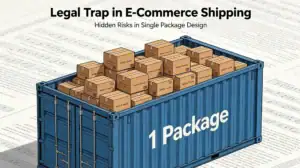
Trap #1: What Counts as “One Package”?
This is a huge one. The limit is calculated per package or unit. But in container shipping, what counts as a package? Is it the container itself (one box), or all the small cartons inside?
Most court cases say: if your bill of lading only says “1 container” without listing how many inner cartons, you’re treated as having only one package. So a full 40-foot container packed with 800 e-commerce parcels legally counts as one unit. Do the math—that caps your compensation at a tiny fraction of your real loss.
How to avoid it: In the cargo description section of your bill of lading, clearly state the number of smallest shipping units (e.g., “CARTONS 800”). Then get the carrier to confirm they accept that count.
Trap #2: Exchange Rate Fluctuations
SDR isn’t real money you can spend. You have to convert it into US dollars, euros, or whatever currency you use. Different countries use different dates for the exchange rate—some use the day the ship sailed, others the day the payment is actually made.
If the exchange rate moves significantly during your shipment, your final payout could be lower than you expected. And unless you agreed on a fixed rate ahead of time, the carrier will likely pick the conversion date that favors them.
Trap #3: The 1-Year Time Limit
Under the Hague Rules and the Chinese Maritime Code, you have only one year to file a legal claim against the carrier. That clock starts ticking on the day the cargo was supposed to arrive at the destination port—not the day the container fell into the water.
Once that year passes, you lose your right to claim anything. Even if the carrier should have paid the limit, they no longer have to. So don’t wait.
Practical tip: Send a written notice of claim through your freight forwarder as soon as you learn about the accident. This may pause the clock in some legal systems. Also start gathering your documents—bill of lading, packing list, invoice—immediately.
4. How to Protect Yourself Without Buying Insurance (Or Even If You Do)
Sure, cargo insurance is the safest route. But some shippers skip it to save costs or because they’re used to doing things a certain way. If you fall into that group, here are some legal moves you can make to raise your potential payout or lower your risk:
-
Declare a higher cargo value and pay extra freight – Most carriers let you choose a “declared value” option. Pay an additional percentage of the excess value, and they’ll agree to cover your goods at that higher amount instead of the convention limit. You must do this when booking—no retroactive requests.
-
Ask for written confirmation on how packages are counted – When booking, send an email or add a note clearly asking for the bill of lading to show each inner carton as a separate package. Keep their reply. If they refuse, consider switching to another carrier.
-
Keep loading photos and weight records – Take videos of the stuffing process, photos of the seal number, and weighbridge tickets. If a container goes overboard, this evidence proves your cargo was in good shape and the count was correct—stopping the carrier from claiming bad packing or quantity mismatch.
-
Negotiate a higher limit in your contract – If you ship regularly, try to get a long-term contract that applies the Hamburg Rules (835 SDR per package) or even an agreed higher figure like 2000 SDR per package. This works much better for volume shippers than for one-off bookings.
-
Pick a carrier with good P&I Club membership – Even with liability limits, some carriers are better at paying claims than others. Check whether the shipping line belongs to the International Group of P&I Clubs (IG P&I)—those are generally more reliable when something goes wrong.
-
Split your cargo into multiple bills of lading – If you’re shipping several containers on the same vessel, ask for each container to get its own separate bill of lading instead of one combined document. That way each container counts as its own “package,” and your total compensation ceiling multiplies.
5. Quick Q&A – Legal Questions Answered Simply
| Question | Short Answer |
|---|---|
| Does the carrier always pay when a container falls into the sea? | No. If it’s a navigation or management mistake, they only pay the capped limit, not full value. |
| What’s the maximum payout for one container? | Depends on how packages are counted and which rules apply—no fixed number. |
| What should I do first after hearing my container is overboard? | Immediately notify your forwarder and carrier in writing, and tell the destination agent not to move anything. |
| When can a carrier lose the right to limit liability? | If the ship was unseaworthy and that caused the loss, or if the carrier acted intentionally or recklessly. |
| Where do I have to file the lawsuit? | Wherever the bill of lading says—usually London, New York, Hong Kong, or Singapore. |
| What happens if I have cargo insurance? Does the carrier still pay? | Your insurer will pay you first, then they’ll go after the carrier for the limit amount. |
| When does the 1-year deadline start? | On the scheduled arrival date at the destination port—not the accident date. |

ABout AMZ Shipper
AMZ Shipper has several years of experience for international logistics Freight Forwarding service. Our service is for importer and exporter, foreign freight forwarders, local and abroad business. Export of 1500 of 40HQ per year for FBA Amazon shipping, 15-30tons of air shipments per month.
Member of WCA. Our company is a professional Amazon freight forwarder that specializes in providing comprehensive and efficient services to customers.