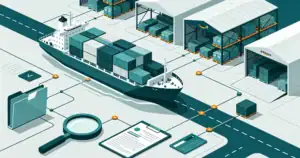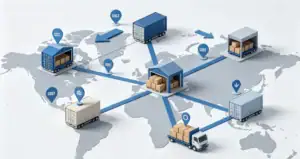
As of early June 2026, over 450,000 TEU of container ship capacity is waiting outside Singapore’s port. The average anchorage waiting time has stretched to 5–7 days. Several shipping lines have already announced congestion surcharges on some routes, or have started skipping Singapore or adjusting their port rotation schedules.
For shipments that rely on Singapore as a transshipment hub — especially Asia-Europe, Asia-Africa, and Middle East routes — actual voyage delays can reach 2–3 weeks. Transshipment bookings are harder to secure, and the risk of extra charges from containers staying too long at the terminal is rising.
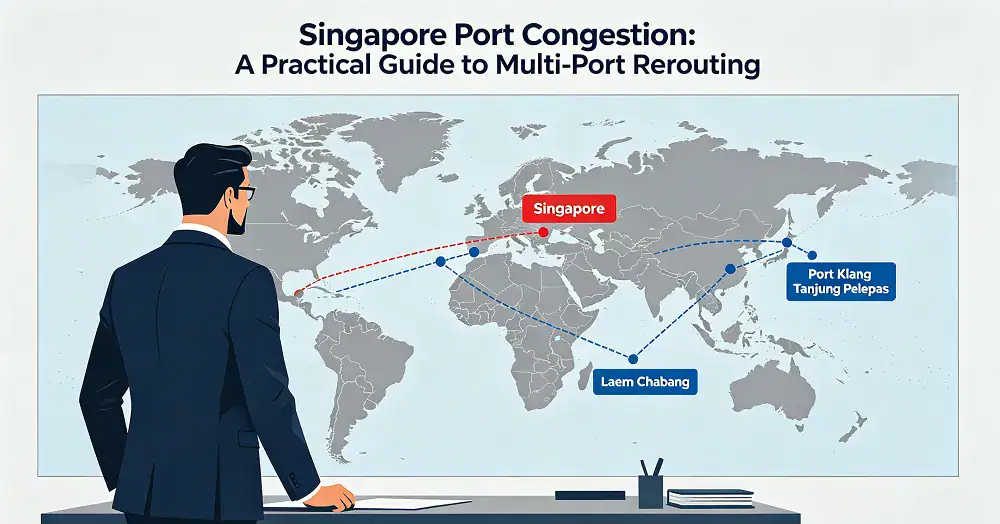
This guide provides three workable alternative port options, along with practical steps and a risk control checklist — all based on current rerouting experience.
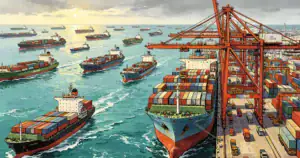
1. Congestion Status and Affected Routes
The main operational reasons for the current congestion are straightforward: rerouting around the Red Sea has increased pressure on major Asian transshipment ports; some berths at Singapore are being upgraded for automation, reducing available capacity; and the southwest monsoon in June has affected vessel punctuality.
Three types of shipments are hit hardest:
-
Far East – Europe (second‑leg transshipment via Singapore)
Cargo from China, South Korea, and Japan heading to Northern Europe and the Mediterranean. Some carriers have stopped accepting new bookings that require transshipment through Singapore. -
Southeast Asia – Africa
Shipments to Nigeria, South Africa, Kenya, and other African countries heavily depend on Singapore for consolidation. Current waiting times are significantly longer. -
Middle East – Northeast Asia (return leg)
Westbound vessels returning to China and South Korea are facing schedule disruptions because of congestion, making return‑leg space unreliable.

2. Three Alternative Ports for Rerouting: A Practical Comparison
Option 1: Port Klang, Malaysia
Port Klang is about 300 km from Singapore and is currently the most popular alternative. It has two main terminals: Westport (newer and more efficient) and Northport (older).
Advantages:
-
Many carriers have added extra calls at Port Klang. It covers Europe, Africa, and the Middle East.
-
Short distance from Singapore — feeder or barge transfer time is low.
-
Westport has a mature transshipment system that handles complex container movements.
Operational challenges:
-
Some berths at Northport are older, and waiting times there can be 1–2 days longer than at Westport.
-
Trucking capacity around Port Klang is under high demand — early booking is necessary.
-
Malaysian customs require detailed documentation for certain product categories.
Best for:
Shipments destined for West Malaysia, or cargo that can go by rail to Thailand. Also suitable for non‑urgent shipments that can tolerate an extra 3–5 days of transit time.
Option 2: Tanjung Pelepas, Indonesia
Tanjung Pelepas (TPP) is a modern container terminal in the Riau Islands of Indonesia. Several major carriers have dedicated berths and container yards there.
Advantages:
-
Highly automated terminal. Current anchorage waiting time is typically 1–2 days.
-
Several global carriers use TPP as a regional secondary hub, offering wide route coverage.
-
Customs system integrates with other Indonesian main ports — transshipment data can be submitted electronically.
Operational challenges:
-
The domestic feeder network in Indonesia is less dense than Singapore’s. Cargo heading east of Java may need an extra vessel transfer.
-
Transshipment documents must include an Indonesian customs form, which has different formatting requirements.
-
Empty container availability is more limited — you must confirm with the carrier before picking up boxes.
Best for:
Cargo destined for eastern Java, Bali, or shipments that will transit through Jakarta. Also suitable for shippers familiar with Indonesian customs procedures.
Comparison of three alternative ports
| Aspect | Port Klang (Westport) | Tanjung Pelepas | Laem Chabang |
|---|---|---|---|
| Current anchorage waiting time | 2–3 days | 1–2 days | Less than 1 day |
| Main route coverage | Europe, Africa, Middle East | Europe, Africa, Trans‑Pacific | Asia short‑sea, Australia/New Zealand |
| Document complexity | Medium | Medium (requires Indonesian transit form) | Higher (multi‑modal coordination) |
| Local truck availability | Tight – book early | Relatively available | Available |
Option 3: Laem Chabang, Thailand
Laem Chabang is Thailand’s largest container port, about 130 km southeast of Bangkok. Its strength lies more in its land network than in deep‑sea connections.
Advantages:
-
Stable short‑sea routes to Cambodia, southern Vietnam, and southern China.
-
Road and rail networks in Thailand’s Eastern Economic Corridor connect to Laos and Myanmar.
-
Very short vessel waiting times — almost no anchorage queue at the moment.
Operational challenges:
-
Deep‑sea vessel calls are less frequent. You need to confirm with the carrier whether they accept Laem Chabang for long‑haul transshipment.
-
Sea‑land coordination involves multiple customs offices in Thailand and neighboring countries.
-
Cross‑border rail to Laos does not run daily — you must check the schedule with your forwarder.
Best for:
Cargo destined for Thailand, Cambodia, Laos, Myanmar, or southern Vietnam. Also suitable for non‑urgent shipments that can use land connections.
3. Step‑by‑Step Rerouting Process and Risk Control Checklist
The following steps are based on real cases. Adjust them according to your specific carrier and cargo situation.

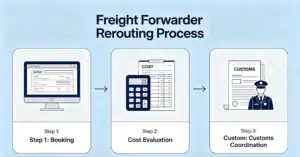
Step 1: Immediately confirm alternative port booking feasibility for urgent cargo
Contact your current booking carrier or freight forwarder. Provide your original booking reference and ask clearly:
-
Do you accept changing the destination or transshipment port to Port Klang, Tanjung Pelepas, or Laem Chabang?
-
If yes, is vessel space available? What is the new vessel name and voyage number?
-
Do I need to resubmit export customs documents from the origin port?
Tip: Request written confirmation (email or booking confirmation) to avoid disputes later.
Step 2: Evaluate detention fees and destination change charges
The most direct financial risk from transshipment delays is container detention (late fees). Complete the following checks:
-
Ask the carrier for the current free‑time deadline for your container, and whether they waive detention charges due to congestion.
-
Request the administrative fee for changing the destination port, plus terminal handling charges.
-
If your cargo has already been unloaded at Singapore but not yet transshipped, ask whether it can be trucked to Port Klang to catch the mother vessel.
Step 3: Coordinate trucking and customs clearance at origin and alternative ports
Local operational capacity at the alternative port directly affects final delivery time. Start immediately after confirming the port change:
-
At origin port: If the final discharge port on the bill of lading changes, you may need to resend customs data or file an export amendment.
-
At the alternative port: Contact your local clearance agent in advance. Confirm they have received either the transit document or the direct bill of lading.
-
Truck booking: Port Klang currently requires booking at least 3 working days ahead. Tanjung Pelepas and Laem Chabang have more capacity, but early confirmation is still advised.
Step 4: Update the estimated arrival time for your end buyer
Clear and timely communication reduces commercial disputes. Use these key messages:
-
Explain that “regional port congestion has caused a schedule adjustment” — not just a single carrier delay.
-
Provide the new vessel name, voyage number, and revised estimated arrival date.
-
Give a realistic delay range (e.g., “approximately 10–14 days later than originally planned”).
Rerouting Operations Checklist
Use this checklist to avoid missing critical steps during port change:
-
Obtain written confirmation from the carrier for the alternative port booking
-
Calculate all extra costs (detention, port change fee, etc.) and get buyer approval
-
Get contact info and a quote from the local customs clearance agent at the alternative port
-
Complete trucking booking at the alternative port (confirm vehicle type, arrival time, and backup plan for overtime)
-
Notify your cargo insurer about the route and port change, and amend the insurance policy
-
Track the container entering the alternative terminal and get the gate‑in receipt
-
Send the updated shipping documents to the final consignee
4. Common Practical Issues in Current Rerouting Operations
Based on feedback from the past few weeks, three points deserve special attention:
Issue 1: Who pays for the original Singapore leg fees after rerouting?
Most carriers treat operational changes caused by public port congestion as the shipper’s responsibility. However, some long‑term contracts with forwarders may allow cost sharing. Clarify this before confirming the new booking.
Issue 2: How to choose between Westport and Northport at Port Klang?
If the carrier offers a choice, ask for Westport first. Westport has more stable terminal efficiency, better IT systems, and stronger support services. Only consider Northport if Westport’s berth waiting time exceeds 4 days.
Issue 3: How to handle multimodal documentation when using Laem Chabang plus land transport?
Ask your freight forwarder whether they can issue a single through bill of lading. In most cases, the ocean leg and land leg will need separate transport documents, with a customs handover at the border.

5. What to Expect in the Coming Weeks
According to multiple shipping consultancies, the current congestion at Singapore is expected to last at least until mid‑July 2026, with only slow improvement after the monsoon season ends. Carriers may continue to adjust their port calls on short notice.
For shippers, these preparations make sense:
-
Shift some regular cargo to Port Klang or Tanjung Pelepas to reduce reliance on a single hub
-
Agree on an “emergency rerouting protocol” with your freight forwarder in advance — including prices and procedures — so you can respond quickly if congestion worsens
-
For non‑urgent goods, evaluate whether delaying shipment by 2–3 weeks is cheaper than paying congestion‑related extras
ABout AMZ Shipper
AMZ Shipper has several years of experience for international logistics Freight Forwarding service. Our service is for importer and exporter, foreign freight forwarders, local and abroad business. Export of 1500 of 40HQ per year for FBA Amazon shipping, 15-30tons of air shipments per month.
Member of WCA. Our company is a professional Amazon freight forwarder that specializes in providing comprehensive and efficient services to customers.