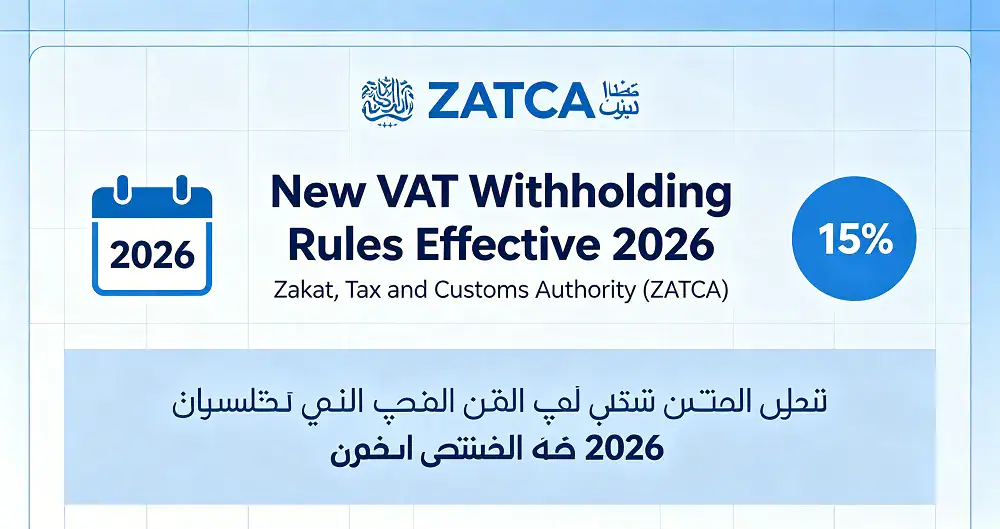
Saudi Arabia’s Zakat, Tax and Customs Authority (ZATCA), together with major e-commerce platforms, officially started enforcing new VAT withholding rules in 2026. Under these rules, cross-border sellers who haven’t provided a valid Saudi VAT number to their platform will have 15% VAT automatically deducted from their sales orders in Saudi Arabia.
This means the deducted tax goes straight to the platform or tax authority, not into the seller’s own cash flow. For sellers who haven’t registered for Saudi VAT, their actual payout shrinks. This article breaks down the rules, the market impact, and the logistics side of things.
1. How the Platform Withholding Mechanism Works
According to official ZATCA announcements and platform seller center notices, here’s how the new rules work:
Who it applies to
Any cross-border B2C sale through a Saudi e-commerce platform is covered. If the seller hasn’t provided a valid Saudi VAT number, the platform will automatically withhold 15% VAT at settlement. The same applies to sellers who have registered for VAT but haven’t correctly uploaded their number to the platform backend.
What happens with the withheld tax
-
Sellers with a valid VAT number: The withheld amount counts as input tax. When you file your periodic VAT return (usually quarterly), you can use it to offset your output tax liability. Your actual tax burden depends on the difference between input and output.
-
Sellers without a valid VAT number: The withheld amount becomes a pure cost. You can’t claim it back or offset it at all.
Timeline
Platforms set a deadline for sellers to upload or update their VAT numbers before 2026 began. Any account that missed the deadline is now in withholding mode. Even if you have a VAT number but it shows as “unverified” in your platform settings, the system treats it as missing and starts deducting.
Comparison of different seller tax statuses
| Tax Status | Platform Withholds? | Can Tax Be Recovered? | Cash Flow Impact |
|---|---|---|---|
| Registered & number uploaded | Yes | Yes, can offset against output tax | Less cash tied up for filing; easier cash flow |
| Not registered or not uploaded | Yes | No, tax is a direct cost | Lower payouts, squeezed margins |

2. Four Impacts on Sellers’ Middle East Strategy
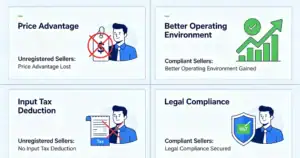
Impact 1: Unregistered sellers lose their price advantage
Some sellers used to skip VAT registration to keep prices low. That approach was always risky, but it did give some cost flexibility. Now that the 2026 rules are in effect, unregistered sellers take a direct 15% hit on their settlement amount.
You basically have two choices: absorb the 15% yourself (which destroys margins), or raise prices to pass it on to customers. But in a competitive market like Saudi, raising prices often means lower conversion rates, more cart abandonment, and worse product rankings.
Impact 2: Compliant sellers get a better operating environment
Before 2026, sellers with a valid VAT number had to calculate the difference between output and input tax each quarter and pay that amount to ZATCA. That meant setting aside a chunk of cash for tax filing. For sellers with decent sales but thin margins, that was a real cash flow burden.
Now that platforms handle output tax withholding, sellers don’t need to reserve cash for the sales-side VAT anymore. You just confirm the withheld amount during your quarterly filing and offset it against the input tax you paid on imports. Your day-to-day cash flow is healthier, and filing is simpler.
Impact 3: Tax compliance becomes a market entry requirement
The 2026 rules aren’t just a tax change — they send a clear signal that Saudi is serious about formalizing e-commerce. Platforms will likely tighten further. Expect things like:
-
Requiring a valid VAT number just to create new product listings
-
Giving compliant sellers better search rankings, event access, and buy box win rates
-
Sharing more data with ZATCA, and restricting or banning accounts that stay unregistered for too long
If you want to play the long game in the Middle East, tax compliance is no longer optional.
Impact 4: Your logistics and customs model needs to match your tax status
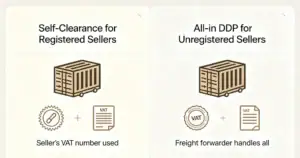
Saudi customs involves paying import VAT at the border. Registered sellers can use their own VAT number for clearance — that import VAT becomes input tax that can be offset later. Unregistered sellers usually rely on freight forwarders who offer “all-in DDP” (delivered duty paid) services.
But under the 2026 rules, if you’re a registered seller but still use your forwarder’s VAT number for clearance, you run into a problem: the import VAT is in the forwarder’s name, so you can’t use it as input tax. Meanwhile, your sales are still subject to platform withholding in your own name. Your input and output are disconnected, and you end up paying more tax than necessary. So your logistics model must match your tax status.
3. Practical Logistics and Compliance Strategies for Sellers
Strategy 1: Get your VAT number and upload it now
If you haven’t registered for Saudi VAT yet, start the process immediately. The 2026 rules are already in effect — every day you wait, you’re losing money on every order. Here’s what you typically need:
-
Company business license (translated and notarized, usually into Arabic or English)
-
Legal representative’s ID and passport copy
-
Screenshots from your Amazon or Noon seller account, plus past or estimated sales figures
-
Power of attorney for a local tax representative in Saudi (if required — non-resident companies often need one)
Registration usually takes several weeks, depending on how fast you prepare documents and how busy ZATCA is. Stay in close contact with your tax agent. Once you get your number, upload it to every platform’s tax settings section immediately, and check that the status shows “verified” or “active.”
Strategy 2: Choose the right customs clearance model for your tax status
If you’re already registered: Use your own VAT number for import clearance (“self-clearance”). The import VAT you pay becomes input tax, which you can offset against the output tax that platforms withheld. This keeps your tax chain clean and avoids mismatches. It’s the right model for long-term sellers with stable volume. You need a freight forwarder who can handle clearance using your number.
If you’re not registered yet (or waiting for your number): Use your forwarder’s “all-in DDP” service as a temporary solution. The forwarder uses their own VAT number and customs broker. You don’t need to deal with import VAT. But treat this as a short-term bridge — once you have your own number, switch to self-clearance as soon as possible to avoid input/output mismatches.
Comparison of clearance models
| Clearance Model | Best For | Import VAT Handling | Coordination with Platform Withholding |
|---|---|---|---|
| Self-clearance (using seller’s VAT number) | Registered sellers | Seller pays import VAT, claims as input tax | Platform withholding = output tax. Can offset in filing |
| All-in DDP (using forwarder’s VAT number) | Unregistered or pending sellers | Forwarder handles it, seller not involved | Seller has no input tax to offset. Temporary use only |

Strategy 3: Align your logistics routing with tax compliance
A complete Saudi logistics setup has three parts:
First-mile (China to Saudi)
Sea freight (FCL or LCL) from major ports like Shenzhen, Guangzhou, Ningbo, or Shanghai to Saudi — typically 20–30 days. Or air freight for faster delivery — usually 3–7 days.
Customs clearance
At ports like Dammam, Jeddah, or Riyadh. Required documents: commercial invoice, packing list, bill of lading, SABER certificate, COC, etc. Speed depends heavily on how complete and accurate your paperwork is.
Last-mile delivery
After clearance, goods can go to a Saudi warehouse (in Riyadh, Jeddah, etc.) for temporary storage, or be shipped directly to the buyer’s door via local couriers. Warehousing allows local delivery, faster shipping, and easier returns.
If you’re registered and using self-clearance, pick a forwarder who can work with your VAT number throughout the process. They need to prepare ZATCA-compliant documents and put your tax number on invoices and customs filings. If you’re still on the all-in DDP model, confirm that your forwarder offers true “DDP door-to-door” — from their China warehouse all the way to the Saudi buyer, including all taxes and fees — so you don’t run into surprises.
Strategy 4: Recalculate your cost structure
The 2026 rules mean you need to re-run your numbers for Saudi, based on your actual tax status. Registered sellers see a 15% withholding, but most of that gets offset by import VAT you’ve already paid. Your actual added tax cost is the difference between output and input — usually much lower than 15%.
Unregistered sellers take the full 15% loss. That gap alone shows why registering pays off — not just for compliance, but for real cost savings. Make registration your top priority for 2026. Once you’re compliant, you can redo your pricing and margin calculations with a clean tax setup.
Strategy 5: Work with both a logistics advisor and a tax advisor
In Saudi, logistics and tax are tightly connected. They have to work together, or you’ll leak money. Set up a two-advisor system:
-
Logistics advisor handles first-mile routing, customs clearance coordination, warehouse inventory, and last-mile tracking.
-
Tax advisor handles VAT registration, quarterly filings, reconciling withheld amounts, and responding to any ZATCA inquiries.
The two need to share information. Your logistics advisor should give your tax advisor the import clearance documents (showing import VAT paid) for every shipment, so the tax advisor can include them in the filing. And your tax advisor should tell your logistics advisor your VAT number status and filing schedule, so the logistics side can set up clearance correctly.

ABout AMZ Shipper
AMZ Shipper has several years of experience for international logistics Freight Forwarding service. Our service is for importer and exporter, foreign freight forwarders, local and abroad business. Export of 1500 of 40HQ per year for FBA Amazon shipping, 15-30tons of air shipments per month.
Member of WCA. Our company is a professional Amazon freight forwarder that specializes in providing comprehensive and efficient services to customers.