
A lot of sellers ask the same question when they’re preparing their first Amazon FBA shipment: how early should I ship?
Someone tells you two months. Someone else says three months during peak season. Someone else says it depends. None of these answers are wrong, but none of them really hit the point – because “how early should I ship” is actually the wrong question. The real question is: how many days of inventory do I have left, and after subtracting transit time and warehouse receiving time, how much buffer do I have?
Amazon FBA shipping timing isn’t a fixed number – it’s the result of a backward calculation. This article won’t give you a standard number of days. Instead, it gives you a calculation method so you can work out your own answer based on your inventory, sales, shipping method, and season.

1. How to Calculate Amazon FBA Shipping Timing – Start by Working Backward
A lot of sellers ask “how early should I ship,” but the real question is “how many days of inventory do I have left.”
The calculation logic:
Days of sellable inventory − transit time − warehouse receiving time − safety buffer = latest ship date
Every variable in this formula varies from seller to seller. Days of sellable inventory depends on your sales. Transit time depends on your shipping method. Warehouse receiving time depends on the Amazon FBA warehouse queue. Safety buffer depends on your tolerance for stockouts.
So there’s no standard answer for “how early to ship” – but there is a calculation method. Work out these four variables, and the answer reveals itself.
2. The Four Variables That Determine Amazon FBA Shipping Timing
Variable 1: Days of sellable inventory
Current inventory ÷ average daily sales = how many days you can keep selling. This is your total time window.
Use the last 30 days of average daily sales, not a historical average – when sales are growing or declining, historical averages mislead you. If sales are rising, your actual sellable days will be shorter than calculated.
Variable 2: Transit time
Different shipping methods vary widely:
-
Ocean FCL/LCL: 25-40 days
-
Air freight: 7-12 days
-
Express: 3-7 days
-
Rail (Europe): 18-25 days
Note this is door-to-door time, not port-to-port. Many sellers only count the time at sea and forget origin handling and last-mile delivery. Door-to-door time can easily be one to two weeks longer than pure ocean transit.
Variable 3: Warehouse receiving time
After goods arrive at the Amazon FBA warehouse, it can take 2-4 days (small parcel) or up to 10 days (LTL/FTL) from Checked In to Receiving – and longer during peak season. During this time, your inventory isn’t sellable yet, so it has to be counted.
A lot of sellers assume “once it’s at the warehouse, it’s available for sale.” It’s not. Arriving at the warehouse is just the first step. Amazon FBA still needs to scan, verify, and shelve it. During that time, your inventory remains unsellable.
Variable 4: Safety buffer
This is the most commonly overlooked variable. Leave at least 7-14 days of buffer to handle customs inspections, weather delays, warehouse congestion, and other uncontrollable factors. During peak season, 14-21 days is safer.
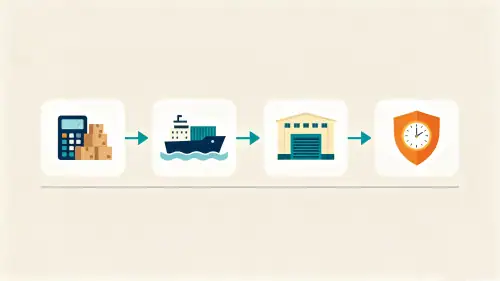
Don’t ship based on the most ideal timeline. Any small delay can cause a stockout – and the cost of a stockout (ranking drops, lower conversion, wasted ad spend) is far higher than the cost of holding a bit more inventory.
3. Amazon FBA Shipping Timeline – A Backward Planning Table
| Step | What to Calculate | Notes |
|---|---|---|
| 1 | Days of sellable inventory | Inventory ÷ average daily sales |
| 2 | Subtract transit time | Based on chosen shipping method |
| 3 | Subtract warehouse receiving time | Small parcel 2-4 days, LTL up to 10 days |
| 4 | Subtract safety buffer | Off-peak 7-14 days, peak 14-21 days |
| 5 | Get the latest ship date | Step 1 minus Steps 2, 3, 4 |
| 6 | Subtract production time | Supplier production cycle |
| 7 | Get the latest order date | Your final decision point |
Key reminder: Steps 6 and 7 are often overlooked. Many sellers calculate the “latest ship date” but forget the supplier still needs production time – so they order too late, and the goods can’t be made in time. If your supplier produces after you place the order, your real decision point isn’t the ship date – it’s the order date.
4. How Early to Ship Amazon FBA Inventory – By Shipping Method
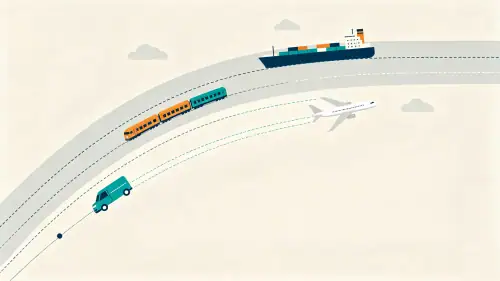
The lead time varies a lot by shipping method. Here’s a rough reference framework:
Ocean FCL
Best for large volumes and non-urgent regular restocks. Ship 45-60 days before your target listing date. If you’re using slow boats, add more lead time.
Ocean LCL
Similar transit time to FCL, but LCL needs to wait for container consolidation, which can add a few days. Ship 50-65 days ahead.
Air Freight
Best for emergency restocks or high-value lightweight goods. Ship 15-25 days ahead. Remember air freight also involves origin handling and last-mile delivery.
Express
Best for stockout rescue or small-batch testing. Ship 7-15 days ahead.
Rail (Europe)
Transit time sits between ocean and air. Ship 30-40 days ahead.
Core principle: these numbers are references, not standards. Your actual lead time should adjust dynamically based on inventory days, sales trends, and peak season factors. Two sellers both using ocean freight – one with 40 days of inventory and one with 90 days – will have completely different shipping rhythms.
5. Why Amazon FBA Sellers Should Ship Earlier During Peak Season
Peak season shipping runs on a completely different rhythm from off-peak. If you plan peak season shipments using off-peak lead times, delays are almost guaranteed.

Three changes during peak season:
Tight space – Peak season space is in high demand. Booking may require longer lead times, and rollover risks increase. If your cargo reaches the port but doesn’t get loaded on time, your restock schedule gets thrown off.
Warehouse congestion – Amazon FBA warehouses handle a surge in volume during peak season. The time from Checked In to Receiving can double. What normally takes 2-4 days can stretch beyond a week.
Higher surcharges – Peak season surcharges often start before the peak actually hits. The later you ship, the more you pay.
Peak season shipping recommendations:
-
Start planning peak season restocks 2-3 months ahead
-
Complete major batches before peak season surcharges kick in
-
Leave a longer safety buffer than off-peak (14-21 days recommended)
-
Consider using overseas warehouses for forward stocking to avoid the peak international transport crunch
Key reminder: don’t wait until peak season is already underway to ship. Space, prices, and warehouse receiving efficiency all get noticeably worse during peak. If Prime Day or Black Friday is your biggest sales event of the year, your shipping plan should start months before those dates.
6. What’s Changed in 2026 for Amazon FBA Shipping Timing
Several changes in 2026 directly affect how you calculate shipping timing.

Change 1: FBA prep and labeling services are gone
Ended for US sites on January 1, 2026, and for European sites on July 1, 2026. Labels must be applied at origin, which can add 1-2 days to origin operations. Factor this into your Amazon FBA shipping timing.
Change 2: New FNSKU label rules
As of March 31, 2026, non-brand-registered sellers must use FNSKU labels. If your supplier needs to re-label, that can add extra time.
Change 3: Inbound defect fees have shot up
Fines for labeling errors and oversized cartons have increased significantly. That means the “just ship it and hope for the best” approach carries more risk – leave more buffer rather than cutting corners to save time. The time you save might not cover the fines.
Change 4: Tighter delivery appointment windows during peak
Amazon FBA warehouse appointment slots get tighter during peak season. Factor appointment waiting time into your Amazon FBA shipping timing.
7. The 6 Most Common Mistakes in Amazon FBA Shipping Timing
Mistake 1: Only counting ocean transit, forgetting origin and last mile
Many sellers calculate “30 days by sea” and assume shipping 30 days ahead is enough. But door-to-door time includes origin handling, ocean transit, customs clearance, and last-mile delivery – easily one to two weeks more than 30 days.
→ Use door-to-door time, not port-to-port time.
Mistake 2: Forgetting warehouse receiving time
Goods arriving at the Amazon FBA warehouse doesn’t mean they’re sellable. From Checked In to Receiving takes time, and during that period, inventory isn’t available.
→ Count those 2-10 days into your time window.
Mistake 3: No safety buffer
Shipping on the tightest possible timeline means any small delay causes a stockout.
→ Leave at least 7-14 days of buffer; 14-21 days during peak season.
Mistake 4: Forgetting supplier production time
You calculate the latest ship date, but your supplier still needs production time. Order too late, and the goods can’t be made.
→ Add production time to your backward calculation, starting from the order date.
Mistake 5: Using off-peak lead times during peak season
Space, warehouse receiving, and appointments are all tighter during peak. Using off-peak lead times for peak season Amazon FBA shipping almost guarantees delays.
→ Add at least 2-4 weeks to your off-peak lead time during peak season.
Mistake 6: Ignoring sales trends
Using historical average sales to calculate inventory days, when sales are growing, your actual sellable days are shorter than calculated.
→ Use the last 30 days of average daily sales and factor in future trends.

Choosing a logistics partner who provides end-to-end tracking and proactively alerts you when warehouse receiving status changes can help you calculate Amazon FBA shipping timing more accurately. For example, AMZ Shipper focuses on cross-border logistics for Amazon sellers, offering both ocean and air freight solutions with support across origin operations, destination clearance, and last-mile delivery. But whoever you choose, the key is finding a team that lets you clearly see where your goods are and when they’ll arrive.
In 2026, Amazon FBA shipping has shifted from “when to ship” to “when to calculate.” Work out your inventory days, transit time, warehouse receiving time, and safety buffer – these four variables determine whether your goods reach the Amazon FBA warehouse before you run out of stock.