
Your goods leave the factory in perfect condition. Then they arrive at the FBA warehouse, you open the carton, and the outer box is crushed with items broken inside. Most cross-border sellers have been through this. The problem usually is not ocean freight itself – it is what happens after the goods enter the first-mile warehouse, during those rounds of handling, stacking, and sorting. The first-mile warehouse cargo damage rate depends heavily on how the goods are “treated” inside the warehouse.
This article starts from where damage actually happens, explains how robotic palletizing and automated sorting physically reduce the first-mile warehouse cargo damage rate, and uses practical resources like the FBA shipping guide, shipping method comparison, and FBA preparation checklist to help sellers build a framework for judging a warehouse’s technical level.

Why Is the First-Mile Warehouse Cargo Damage Rate So High? First, See Where Damage Happens
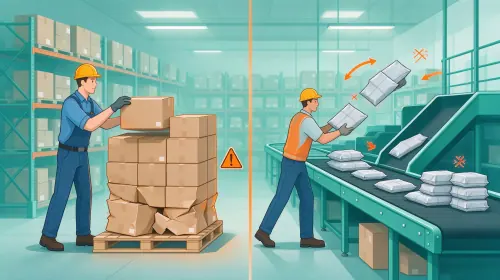
To reduce the first-mile warehouse cargo damage rate, you first need to understand how scattered the causes are. From the moment goods enter a first-mile warehouse to the moment they are loaded onto a vessel, they typically go through six to eight manual handling steps: unloading, scanning, temporary storage, picking, palletizing, wrapping, and loading. Every contact point is a chance for a bump, a squeeze, or a drop. The first-mile warehouse cargo damage rate is not caused by any single step – it is the accumulation of these scattered contact points.
Unstable manual palletizing is one of the main sources of the first-mile warehouse cargo damage rate. When people stack cartons by hand, the orientation, interlocking pattern, and centre of gravity depend heavily on the operator’s experience and how they feel that day. If an unstable pallet tilts during transport, the cartons at the bottom bear far more pressure than their designed load limit. Much of the crushed outer packaging that sellers see during Amazon warehouse delivery actually originates in the palletizing step back at the first-mile warehouse.
Extra handling during sorting also pushes up the first-mile warehouse cargo damage rate. Sorting errors do not just cause wrong deliveries – more commonly, mis-sorted parcels go through extra handling and re-consolidation, and the risk of outer box damage multiplies. This kind of damage often gets classified as “transit damage” in the final tally, when the real cause was in the warehouse. If you review shipment tracking and everything looks normal but the goods arrive damaged, the repeated handling in sorting is worth a closer look.
The peak-season amplification effect deserves special attention. During peak season, the proportion of temporary workers rises, adherence to operating standards drops, and the first-mile warehouse cargo damage rate tends to climb in parallel. Industry observers also note that damaged parcels, transport capacity, and material waste are increasingly being grouped into the same cost challenge, with more companies expecting packaging and damage-related costs to create greater pressure in the coming years.
How Does Robotic Palletizing Reduce the First-Mile Warehouse Cargo Damage Rate? Consistency Is Key
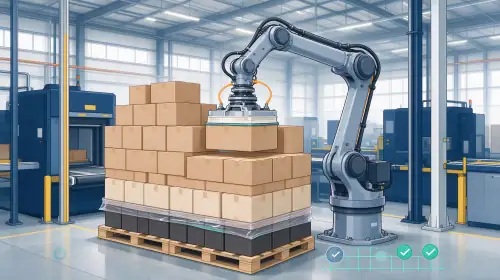
The quality of manual palletizing depends on who is doing it, how they feel that day, and whether they are rushing. The core value of robotic palletizing is not speed – it is doing the same thing to the same standard every single time. One industry summary puts it well: robots do not take leave. Whether it is Monday morning or Friday afternoon, the pallet they build looks the same.
Robotic palletizing reduces the first-mile warehouse cargo damage rate through four main mechanisms:
Controlled grip force. Robotic arms or vacuum grippers pick up cartons with a pre-set force. There is no “toss it over” or “grip it too hard and crush it” moment. For products with softer outer packaging or printed surfaces that bruise easily, this matters a lot.
Interlocking layer algorithms. Software calculates the optimal stacking pattern based on carton dimensions, weight, and load-bearing capacity, keeping the pallet’s centre of gravity stable and the layers tightly interlocked. This reduces the risk of shifting and tipping during transport. A large share of the first-mile warehouse cargo damage rate comes from “pallet collapse crushing the bottom layer” – and algorithmic optimization can largely prevent it.
Layer-level stabilization. After each layer is completed, the system automatically wraps film or inserts a divider to prevent sliding friction between layers from scuffing the carton surfaces. This consistency is very hard for manual operations to maintain over time.
Optimized weight distribution. Heavy goods go on the bottom, light goods on top, and the algorithm assigns positions automatically to prevent the bottom cartons from being crushed. For mixed pallets, this is especially valuable.
| Comparison Point | Manual Palletizing | Robotic Palletizing |
|---|---|---|
| Grip force | Depends on individual feel, highly variable | Constant and controlled |
| Stacking pattern | Experience-driven, different every time | Algorithm-calculated, consistent every time |
| Centre of gravity stability | Varies by person | System-optimized |
| Quality over long shifts | Declines with fatigue | Constant |
| Impact of peak-season temp workers | Significant | Minimal |
For sellers, if your products are electronics, small appliances, glassware, or anything with limited outer-box load capacity, the stability gains from robotic palletizing translate directly into a lower first-mile warehouse cargo damage rate. To understand how damage risk is distributed across different transport modes, the shipping method comparison is a good place to do a side-by-side review of sea, air, and express.
How Does Automated Sorting Reduce the First-Mile Warehouse Cargo Damage Rate? Fewer Unnecessary Touchpoints
In traditional manual sorting, a parcel may go through unloading, scanning, sorting to a chute, carrying to a staging area, scanning again, and loading. Every manual pick-up and put-down is a potential bump. The rise in the first-mile warehouse cargo damage rate during sorting is often not caused by one severe drop, but by too many touchpoints.
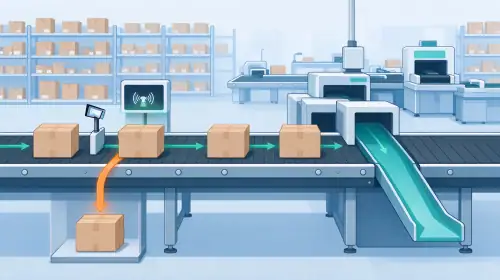
Automated sorting lines move parcels along conveyors and sorting mechanisms, reducing the number of times parcels are thrown, stacked on top of each other, or dropped by hand. Fewer touchpoints mean fewer potential damage points, and the first-mile warehouse cargo damage rate comes down accordingly.
Vision recognition systems add another layer of value. AI vision performs label recognition, dimension measurement, and preliminary appearance checks while sorting. If a parcel already has visible outer damage when it enters the sorting line, the system can flag the anomaly and divert it for separate handling, preventing damaged goods from flowing into the normal process and being handled repeatedly. This shifts control of the first-mile warehouse cargo damage rate from “discovered after the fact” to “intercepted during the process.” This step is closely tied to shipment consolidation – the more standardized the consolidation, the fewer touchpoints in downstream sorting.
There are already reference cases in the industry. At Shenzhen’s first cross-border ecommerce “inspect-before-load” supervision site, smart racks, fully automated sorting lines, and AGV robots are deeply embedded in the entire workflow. Goods go from unloading on arrival to loading for departure in under six hours. The shorter the handling time, the smaller the window in which goods are exposed to handling risk, and the more visible the improvement in the first-mile warehouse cargo damage rate.
How Automation Shapes the Long-Term Trend of the First-Mile Warehouse Cargo Damage Rate
From a longer perspective, improving the first-mile warehouse cargo damage rate is not about any single machine – it is about systematically reducing manual touchpoints across the entire workflow.
Robotic palletizing solves the stacking stability problem. Automated sorting solves the touchpoint frequency problem. Vision recognition solves the anomaly interception problem. When the three work together, the decline in the first-mile warehouse cargo damage rate becomes sustainable. Automation in a single step often has limited effect; only when palletizing, sorting, and inspection form a closed loop does damage improvement actually show up in the data.
The practical takeaway for sellers: when evaluating a first-mile warehouse, do not just look at whether it has robots. Look at whether automation covers the key nodes where damage occurs. Companion resources like the FBA preparation checklist and shipping document checklist also help sellers solve packaging and documentation issues before shipping, reducing damage triggers at the source.

How to Tell Whether a First-Mile Warehouse’s Tech Upgrades Really Reduce the First-Mile Warehouse Cargo Damage Rate
Look at whether palletizing involves automation. Full automation is not required, but at least pallet stacking should be supported by standardized equipment or tooling, rather than relying entirely on manual free stacking.
Look at the number of touchpoints in sorting. Ask your forwarder how many manual handling steps a parcel goes through from warehouse entry to loading. Fewer steps mean fewer potential damage points.
Look at how abnormal goods are handled. Is there a vision inspection or manual pre-check step that identifies and isolates already-damaged parcels before they enter the sorting line?
Look at operational stability during peak season. When the proportion of temporary workers rises, warehouses with higher automation see less fluctuation in handling quality.
Look at data transparency. Is the provider willing to share historical damage rate data or trends, rather than just a verbal promise that “our damage rate is very low”? Providers backed by shipping case studies are usually more willing to let the data speak.
Look at whether automation covers the critical nodes. Palletizing and sorting are high-risk damage points. If automation is concentrated only in low-risk steps like receiving scans, the actual improvement in the first-mile warehouse cargo damage rate will be limited.

If you are mapping out the full chain from factory to FBA warehouse, use the FBA shipping guide and freight planning guide to check each step for high-risk damage points, and tie the value of tech upgrades to specific operational nodes.
As a logistics provider focused on cross-border ecommerce, AMZ Shipper pays close attention to every physical step goods go through in the first-mile warehouse – from palletizing stability to sorting path optimization – helping sellers keep the first-mile warehouse cargo damage rate traceable and improvable.


