
For cross-border sellers and international traders, logistics costs are usually the second largest expense after product procurement. Whether you are an Amazon FBA seller or exporting through traditional trade channels, understanding how international shipping fees are calculated—and exactly where your money goes—is essential. This article breaks down the logic behind freight pricing, step by step, covering ocean freight, air freight, express shipping, and FBA headhaul costs, so you can build a clear cost framework and avoid unnecessary surprises.
1. The Core Concept: The “Hidden Rule” of Chargeable Weight in Shipping Cost
Many sellers are confused when they receive their first freight bill: why does a 10kg shipment get charged at 15kg? The answer lies in a fundamental concept—chargeable weight.
Chargeable weight is not simply the number on the scale. It is the greater of two values: the actual gross weight and the volumetric weight. Cargo space on planes and vessels is limited—lightweight but bulky items (like foam products or inflatable toys) take up just as much room as heavy ones. To keep pricing fair, carriers introduced the concept of volumetric weight to account for the space a shipment occupies.
How Is Volumetric Weight Calculated?
Different transport modes use slightly different formulas:
| Transport Mode | Volumetric Weight Formula | Notes |
|---|---|---|
| Air Freight | Length(cm) × Width(cm) × Height(cm) ÷ 6000 | Industry standard, recommended by IATA |
| Express / Parcel | Length(cm) × Width(cm) × Height(cm) ÷ 5000 | Commonly used by DHL, UPS, FedEx |
| Ocean LCL | Length(m) × Width(m) × Height(m) | Charged per CBM, compared against actual weight ton |
Here is an example: Suppose your shipment weighs 200kg, and the carton size is 100cm × 80cm × 60cm.
-
The volume is 0.48 cubic meters.
-
For air freight, volumetric weight = 100×80×60 ÷ 6000 = 288kg.
-
Since 288kg is greater than 200kg, the chargeable weight is 288kg.

Practical Tips: How to Reduce Volumetric Weight?
Since chargeable weight is the higher of actual and volumetric weight, optimizing your packaging is the most direct way to cut costs. For “light but bulky” goods, consider these steps:
-
Compress packaging: Use vacuum bags to reduce filling materials and wasted space.
-
Right-size cartons: Customize boxes that fit your products more closely, reducing empty space inside.
-
Remove redundancies: Eliminate unnecessary secondary packaging where product safety allows.
In some cases, switching from foam padding to vacuum-sealed packaging can reduce the chargeable weight by up to 40%, leading to significant savings.

2. Breaking Down the Costs: What Makes Up Your Freight Bill?
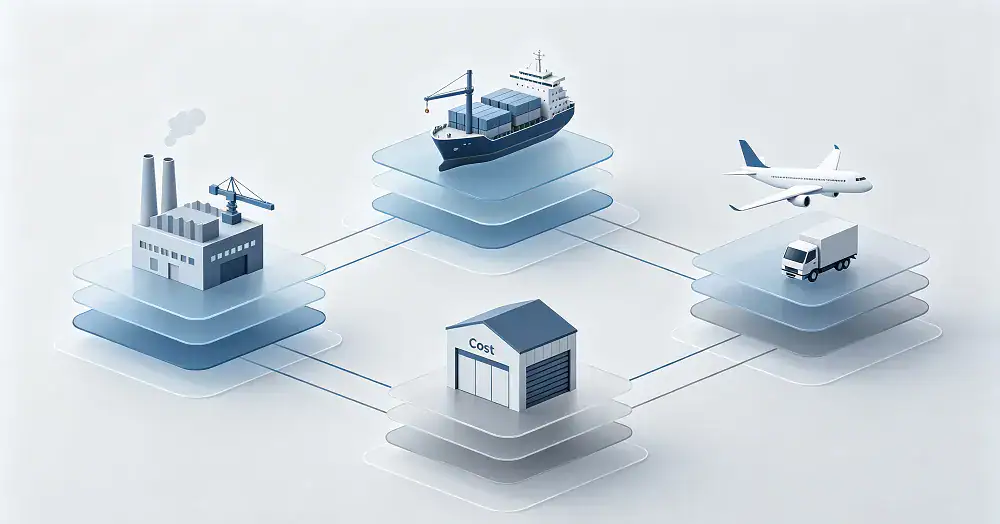
Now that you understand how chargeable weight works, let’s look at what actually appears on your freight invoice. International logistics costs go far beyond “shipping fees”—they typically include several key components.
2.1 Headhaul Transportation Costs
This is the main body of your freight bill, and it varies by transport mode:
-
Ocean FCL (Full Container Load): Charged per container type, such as 20-foot or 40-foot containers. Total cost = base ocean freight + various surcharges.
-
Ocean LCL (Less than Container Load): Charged by volume (cubic meters) or weight (tons), whichever is greater. There is usually a minimum charge—for example, anything under 1 CBM may still be billed as 1 CBM.
-
Air Freight: Charged by chargeable weight (as calculated above). Rates are significantly higher than ocean freight, suitable for high-value or time-sensitive goods.
-
International Express: Also based on chargeable weight, but often uses a stricter divisor (e.g., ÷5000), with the fastest delivery and highest price.
2.2 Various Surcharges
Surcharges are where freight bills get complicated—and where “surprise” fees often hide. Common ones include:
-
Fuel Surcharge: Fluctuates with global oil prices and can make up a large portion of your total freight cost, sometimes even exceeding the base rate.
-
Port Congestion Surcharge: Added when the destination or transit port is heavily congested, to cover extra operational costs.
-
Peak Season Surcharge: Applied during busy shipping periods (like Q4) when carriers adjust rates to manage capacity.
-
Oversized / Overweight Surcharge: Applied when a single piece exceeds certain limits (e.g., over 2 tons or 9 meters), requiring special handling equipment.
-
Currency Adjustment Factor: May be added if the billing currency depreciates significantly against the carrier’s base currency.
2.3 Customs Duties and Taxes
This portion is not paid to the carrier, but to the customs authority of the destination country. It includes import duties, value-added tax (VAT), consumption tax, and others. The amount depends on the product’s HS code (tariff classification), country of origin, and declared value. Misclassifying your HS code can lead to substantially higher duty rates or even cargo detention—so proper research and compliance upfront are critical.
2.4 Storage and Handling Fees
If you use an overseas warehouse or FBA, you will also encounter:
-
Storage Fees: Charged daily or monthly based on the volume (cubic feet or cubic meters) your inventory occupies.
-
Handling Fees: Including inbound receiving, pick-and-pack, labeling, repackaging, and palletizing.
Notably, Amazon FBA prep services—such as labeling, bundling, and bagging—are no longer offered by Amazon as of January 2026. Sellers must now handle these tasks themselves or outsource them to third-party providers. Choosing a logistics partner that offers transparent, standardized prep pricing can help keep these costs under control.
2.5 Last-Mile Delivery Costs
After your cargo arrives at the destination port or airport, it still needs to be delivered to the final warehouse or consumer, usually via local carriers like UPS, FedEx, or regional trucking companies. Charges are based on delivery distance, parcel dimensions and weight (again using the chargeable weight rule), and the service level selected.

3. Choosing the Right Transport Mode: Cost vs. Speed
There is no one-size-fits-all answer when it comes to selecting a shipping method. The right choice depends on your product characteristics and business needs. Here is a quick comparison:
| Transport Mode | Pricing Basis | Typical Transit Time (China to US) | Best For |
|---|---|---|---|
| Ocean LCL | Per CBM or ton, whichever is greater | 25-40 days | Non-seasonal standard items, bulky furniture, low-value goods |
| Ocean FCL | Per container (20’/40′) | 25-40 days | Large-volume shipments that fill a full container |
| Air Freight | Chargeable weight (÷6000) | 5-10 days | High-value electronics, emergency restocking, new product testing |
| International Express | Chargeable weight (÷5000) | 3-7 days | Urgent documents, high-value samples, must-arrive-yesterday scenarios |
When choosing a mode, look beyond the freight rate and calculate the total landed cost. Ocean freight is cheaper but ties up capital for longer and increases inventory risk. Air freight costs more but can prevent stockouts and lost sales. Experienced sellers often use a mixed strategy—for example, moving 90% of steady-selling inventory by sea and reserving air freight for 10% of urgent replenishment.

4. Practical Tips for Keeping Logistics Costs Under Control
-
Read your quote carefully—avoid “all-inclusive” pricing: Always ask your logistics provider for a detailed, line-item quotation that clearly states how each charge is calculated and estimated. This helps you understand the cost structure and prevents unpleasant surprises when the final bill arrives.
-
Optimize volumetric weight: As mentioned earlier, smarter packaging is one of the cheapest ways to save money.
-
Plan your replenishment schedule: Avoid last-minute rushes that force you into expensive air or express shipping. Plan ahead to take advantage of lower ocean freight rates. Also, clear out slow-moving inventory from overseas warehouses to avoid costly long-term storage fees.
-
Choose the right logistics partner: Work with providers that have a reliable global agent network (such as WCA members), offer end-to-end shipment tracking, and provide clear service commitments. This minimizes hidden costs and reduces your own management overhead.
Understanding how international freight costs are calculated is a fundamental skill for anyone in cross-border trade. From grasping the basic “chargeable weight” rule to decoding every line item on your invoice, and finally to combining transport options that best fit your business—mastering these steps alone can help you avoid many unnecessary expenses down the road.
ABout AMZ Shipper
AMZ Shipper has several years of experience for international logistics Freight Forwarding service. Our service is for importer and exporter, foreign freight forwarders, local and abroad business. Export of 1500 of 40HQ per year for FBA Amazon shipping, 15-30tons of air shipments per month.
Member of WCA. Our company is a professional Amazon freight forwarder that specializes in providing comprehensive and efficient services to customers.