A New Phase for European E‑commerce: Logistics Is No Longer Just the “Last Step”
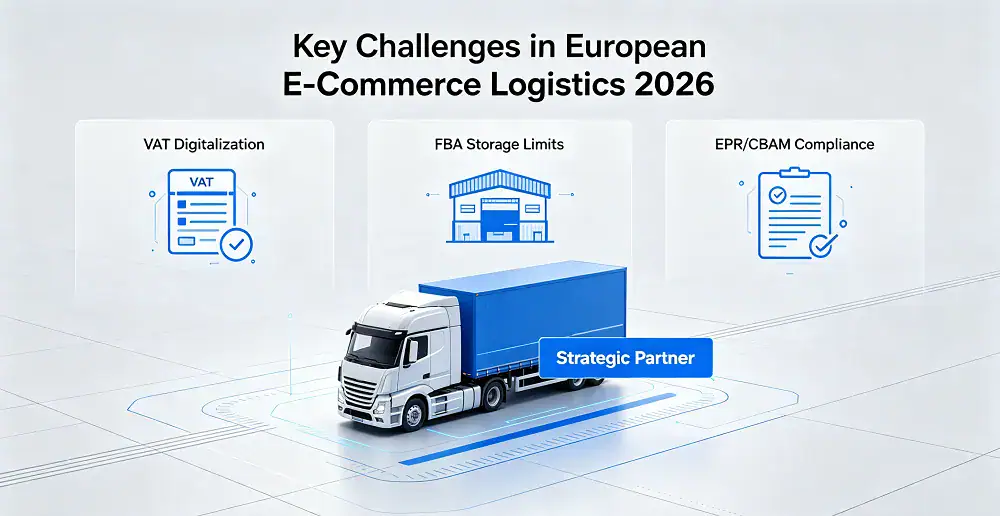
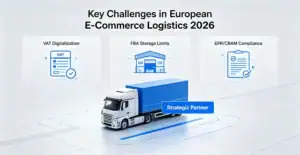
By 2026, the European e‑commerce market will be going through some real structural changes. The full digitalisation of VAT, tighter FBA storage rules from Amazon, and new compliance requirements like the EPR and the Carbon Border Adjustment Mechanism (CBAM) are all reshaping how sellers need to operate. In this environment, just moving goods from A to B isn’t enough anymore — logistics must include compliance checks, inventory flexibility, and local responsiveness.
For international logistics providers, the game has shifted. They are no longer just freight forwarders but strategic partners who help sellers manage supply chains across borders. This article walks through the three main challenges mentioned above and looks at practical ways to handle logistics in the EU in 2026.
Challenge 1: The Full Digitalisation of VAT – From Filing Returns to Managing Cash Flow
What’s Changing by 2026 – Real Time, Mandatory, Pan‑European
The EU’s “VAT in the Digital Age” (ViDA) plan is being rolled out between 2024 and 2026. By 2026, the following changes will be in full effect:
-
E‑invoicing + real‑time reporting: For B2B transactions, VAT data must be submitted through a digital portal within two working days.
-
OSS/IOSS scope expands: These schemes now cover not only distance sales but also more marketplace scenarios where platforms collect VAT on behalf of sellers.
-
Inventory triggers VAT registration: If you use Pan‑European FBA or third‑party warehouses, having stock in a country will likely require you to register for VAT there.

How Logistics Can Respond
Logistics providers now play a bigger role than just delivering shipments. They can help sellers stay ahead of VAT rules in the following ways:
-
Use VAT deferral customs clearance: Instead of paying import VAT at the border, you defer it until after the sale is made. This requires a reliable customs broker at the EU entry point.
-
Flag VAT risks before shipping: Based on the origin country, destination country, shipment value, and whether the platform will collect VAT, you can assess whether a local VAT registration or OSS filing is needed.
-
Integrate with local tax agents: Keep a clean document flow from customs clearance to VAT filing, so missing data doesn’t lead to fines.
| VAT risk point | Logistics‑related solution |
|---|---|
| Holding stock in multiple countries triggers multiple registrations | Provide a “stock distribution report” to flag registration requirements |
| IOSS/OSS data doesn’t match customs declaration | Match the IOSS number with the customs invoice before dispatch |
| VAT deferral is questioned by local authorities | Keep complete transport and storage records for audit support |
Challenge 2: Tighter FBA Storage – From Passive Limits to Active Multi‑Warehouse Planning
What FBA Storage Looks Like in 2026
Amazon Europe continues to optimise how it uses warehouse space. Here’s what’s likely to happen:
-
The IPI (Inventory Performance Index) threshold may go up from the current 400–500 range.
-
A “storage utilisation surcharge” could apply to items that sit for over 270 days with low turnover.
-
Peak‑season capacity auctions may continue, but the cost is too unpredictable for normal restocking.
The Rise of the Hybrid Warehouse Model
Relying entirely on FBA is becoming riskier. A more balanced structure looks like this:
-
FBA for your best‑selling items: Products with high turnover, small volume, and fast sales.
-
Third‑party warehouses for long‑tail or seasonal goods: Use them as a buffer or for products that don’t move as quickly.
-
Direct small parcels for testing or urgent restocks: Useful for new products or when you temporarily have no FBA capacity.
Under this model, freight forwarders can adjust their role to offer:
-
Temporary storage in China or at EU border warehouses – hold large shipments and release them in batches depending on current FBA capacity.
-
Scheduled delivery – help sellers book and deliver within 24‑48 hours after Amazon frees up storage space, avoiding rejection.
-
Turnover alerts – give sellers a 30‑day heads‑up when IPI scores are trending down, so they can move or discount stock early.

| FBA capacity problem | Logistics response |
|---|---|
| Storage space suddenly shrinks at month/quarter end | Activate “hold & split” – move goods to a third‑party warehouse and wait for the next window |
| Peak‑season capacity auction is too expensive | Encourage sellers to start head haul + hold services 90 days ahead |
| Slow‑moving goods are blocking useful space | Offer local return or disposal services in Europe |
Challenge 3: Cross‑Border Compliance – More Than Just Tariffs, It’s Your Entry Ticket
The 2026 Compliance Checklist You Can’t Ignore
Compliance in Europe has moved beyond tax and now covers the entire product lifecycle. The following areas will face stricter customs checks in 2026:
-
EPR (Extended Producer Responsibility) – Germany, France, Italy, and others require registration numbers for packaging, electronics, batteries, etc., plus annual reporting of recycling weight.
-
CBAM (Carbon Border Adjustment Mechanism) – For steel, aluminium, cement, fertilisers, and electricity, importers must report embedded carbon emissions. This may later evolve into a certificate system.
-
ICS2 (Import Control System 2) – All goods entering the EU must submit complete, accurate descriptions, HS codes (at least 6 digits), and recipient details before arrival. Vague descriptions like “parts” or “daily necessities” will get blocked immediately.

How Logistics Can Make Compliance More Practical
These requirements can’t be solved with a one‑size‑fits‑all customs declaration. They need to be built into every shipment instruction:
-
Pre‑compliance checklist – before the seller ships, the system automatically checks which EPR categories apply based on HS code and destination, whether CBAM is relevant, and if the ICS2 fields are complete.
-
Block non‑compliant cargo at the source – stop orders at the China warehouse if a registration number is missing or the description is too vague, rather than having goods destroyed upon arrival.
-
Local partner network – connect with authorised representatives, recycling companies, and carbon accounting firms, offering compliance as an optional service module.
The practical approach is to give each seller a destination‑specific compliance sheet before every shipment, clearly listing the minimum requirements for VAT, EPR, and customs pre‑declaration. This adds a step but significantly reduces the chance of customs holding your goods.
What Logistics Providers Need to Be Able to Do
Given these three big challenges, logistics companies need to build a new set of capabilities:
-
VAT‑aware document flow – automatically apply IOSS/OSS logic and deferral rules on shipping papers.
-
FBA capacity sensing – adjust head‑haul timing based on Amazon’s policy changes.
-
Living compliance database – keep EPR categories, CBAM rules, and HS code requirements updated by country.
-
Flexible storage network – includes at least an export warehouse in China, a buffer warehouse near the EU border, and destination‑country warehouses.
-
24‑hour response – when capacity or policy changes suddenly, you can reach the seller and adjust the shipping plan quickly.
-
Multi‑role visibility – sellers, finance teams, operations, and customs brokers should all see the compliance status and FBA capacity fit on the same order screen.
Practical Timeline for 2026 EU Logistics
-
Q2 2025 – Check whether your current EPR registration numbers cover 2026, especially German packaging law and French multi‑category EPR.
-
Q3 2025 – Review your FBA inventory structure and decide which SKUs would benefit from a third‑party warehouse buffer.
-
Q4 2025 – Test VAT deferral customs routes with your logistics partner, making sure the broker is ready for the 2026 ViDA data format.
-
Q1 2026 – Implement a pre‑shipment compliance check (either your own system or via your logistics partner) and enforce it.
-
Q2 2026 – Watch for Amazon Europe’s announcements on IPI thresholds and storage surcharges, and adjust your warehouse split plan accordingly.
You can shorten or stretch this timeline depending on your product categories and target countries. The core idea stays the same: turn compliance and capacity management from a reactive headache into a proactive plan.

Final Thought
The real challenge of EU e‑commerce logistics in 2026 is no longer about who is “fastest” or “cheapest”. It’s about predictability — can you still get goods delivered and checked into Amazon on time when VAT rules change, FBA space tightens, and customs data requirements get tougher? This means logistics providers need to embed tax logic, inventory strategy, and compliance checklists into their daily operations, not treat them as occasional add‑ons.
For sellers, the criteria for choosing a logistics partner should also change. Beyond just price and transit time, ask whether your partner has real pre‑compliance ability, a way to work with FBA capacity limits, and fast local knowledge of changing regulations. These “non‑shipping” capabilities may well determine the lower limit of your business safety in the 2026 EU market.
ABout AMZ Shipper
AMZ Shipper has several years of experience for international logistics Freight Forwarding service. Our service is for importer and exporter, foreign freight forwarders, local and abroad business. Export of 1500 of 40HQ per year for FBA Amazon shipping, 15-30tons of air shipments per month.
Member of WCA. Our company is a professional Amazon freight forwarder that specializes in providing comprehensive and efficient services to customers.