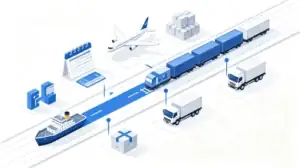
For Chinese sellers looking to break into North America, the U.S. is usually the first stop. But when you start expanding into Canada, many sellers quickly find out that simply copying their U.S. logistics strategy doesn’t work. You run into unexpected cost spikes, longer delivery times, and various delays. That’s because the logistics systems in the U.S. and Canada are built quite differently—from how customs works to how the last mile is handled. Understanding these differences early on will help you adjust your freight, warehousing, and delivery plans, and lower the risks of expanding across North America.
1. Geography & Population: How They Shape the Last Mile
The geography of each country directly affects how dense and efficient its logistics networks are.
The U.S. covers about 9.16 million km² with a population of 330 million. People are heavily concentrated in two main coastal areas (New York, Los Angeles, San Francisco, etc.), and there are also several large inland cities with over a million people (Chicago, Houston, Atlanta). This supports a dense, standard delivery network. USPS, UPS, and FedEx cover almost every residential address. Even remote areas cost a bit more but are generally reliable.
Canada is about 9.98 million km² but has only 38 million people. On top of that, about 70% of its population lives within 100 miles of the U.S. border, mostly around Toronto, Montreal, Vancouver, and Calgary. This means:
-
Most consumers live relatively close to the border, but Canada’s internal logistics distances are huge—it’s over 4,000 km from Vancouver to Toronto, about the same as Beijing to Urumqi.
-
Canada Post handles most remote deliveries, but it’s slower than U.S. private carriers. Private companies like Purolator, Canpar, and FedEx Canada work well in big cities, but shipping to northern or rural areas often comes with extra “remote area fees.”
What this means for you:
-
When shipping to Canada, don’t just look at the country’s size. You need to check whether the delivery address falls within the carrier’s standard network. For example, shipping to downtown Toronto costs about the same as shipping to New York, but sending a package to Yukon can cost several times more than shipping to Toronto.
-
A smart strategy is to use multiple warehouse locations. For slow-moving or bulky items, ship them to a third-party warehouse in Vancouver or Toronto, then use local couriers for final delivery. For fast-moving small items, use Amazon FBA Canada warehouses like YXX2 or YYZ4 to stay close to buyers.

2. Customs & Clearance: Big Differences in Duty-Free Thresholds & Compliance
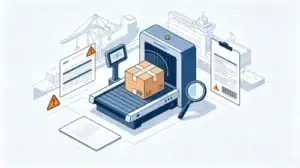
Customs policies in the two countries are one of the most common sources of unexpected delays and extra costs.
| Comparison | United States | Canada |
|---|---|---|
| De minimis (duty-free threshold) | Relatively high (good for low-value parcels) | Very low (most goods require formal entry and taxes) |
| Main customs agency | CBP (U.S. Customs and Border Protection) | CBSA (Canada Border Services Agency) |
| Common product certifications | FCC (electronics), FDA (food/medical), CPSC (children’s products) | ICES (electronics), CFIA (food), CCPSA (children’s products), CSA (electrical) |
| Clearance speed (typical) | Faster (unless inspected) | Slightly slower (closer document review) |
Note: These times refer to standard commercial or air courier shipments. Sea freight or peak seasons may vary.
Key practical points:
-
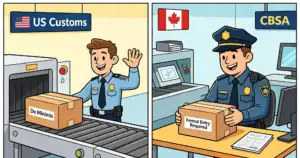
The U.S. has a much higher duty-free threshold, which makes low-value small parcels cost-effective. Canada’s threshold is so low that almost everything—even samples—requires formal customs entry and payment of duties and GST/HST. So if you’re selling low-priced products, shipping directly to Canada will usually cost you a lot more than shipping to the U.S.
-
CBSA is stricter about checking product certifications. For example, for lithium battery products, UN38.3 reports are usually enough for the U.S., but Canada may also require bilingual (English/French) safety instructions and CSA certification. Missing documents can hold your goods for weeks or even get them sent back.
-
Solution: work with a dedicated Canadian customs broker to pre-check your products. AMZ SHIPPER partners with customs brokers on both sides of the border. We can review your product ASIN or model number before shipping and give you a compliance report, helping you avoid unexpected inspections by CBSA.
3. Amazon FBA Warehouses: Capacity, Appointments, and Warehouse Assignment
The differences in FBA infrastructure directly affect how much it costs you to hold inventory in each country.
U.S. FBA:
-
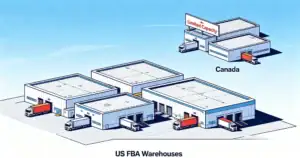
Number of warehouses: Over 150 fulfillment centers covering all major regions.
-
Warehouse assignment: Amazon often splits your shipment across multiple FCs (e.g., West, East, Midwest), which can lead to inbound placement fees.
-
Peak season appointments: During Q4, hot warehouses (like LAX9 or SMF3) can have wait times of days to over a week.
Canada FBA:
-
Number of warehouses: About 10-12 main centers, mostly in Ontario (YYZ series, e.g., YYZ4, YYZ7) and British Columbia (YXX2, YVR3).
-
Warehouse assignment: Less splitting, but capacity is limited. In peak seasons, you may hit storage limits and can’t create new shipments.
-
Inbound speed: Outside of peak times, it’s fairly stable from port to FC, but winter snow can add a week or more.
Practical advice:
-
For Canada FBA, use a “warehouse locking” service. AMZ SHIPPER can help you send all your goods to either YXX2 (near Vancouver) or YYZ4 (near Toronto), reducing Amazon’s split fees. You pay a small fee for this, but it’s often cheaper than paying Amazon’s placement fees.
-
If your Canada sales aren’t stable yet, try “virtual warehouse” fulfillment—use Amazon’s Remote Fulfillment from the U.S. to ship to Canadian customers. You’ll pay cross-border fees and wait an extra few days, but it’s good for testing. For the long term, it’s better to stock directly in Canada.
4. Inland Transport Costs & Speed: Trucking, Rail, and Winter Challenges
From the port of entry (like L.A. or Vancouver) to the warehouse or customer, inland transport is where hidden costs often hide.
Inland transport in the U.S.:
-
Truck network: The interstate highway system is highly developed, and trucking competition keeps rates fairly transparent.
-
Intermodal: Truck + rail is mature and good for heavy, non-urgent goods.
-
Winter impact: Northern states see snow, but major highways are cleared quickly.
Inland transport in Canada:
-
Heavy reliance on rail: CP and CN handle much of the east-west freight. But the last stretch from a rail yard to small towns often needs extra trucking.
-
High winter risk: From November to March, cold weather means:
-
Extra costs for diesel anti-gel, tire chains, etc.
-
Some highways (like the Coquihalla in B.C.) can close without warning due to avalanche risk.
-
So it’s wise to add several extra days of buffer time for inland shipping in Canadian winter.
-
-
Cost example: Shipping the same size container from Vancouver to Toronto (~4,300 km) by rail+truck usually costs more than shipping from L.A. to New York (~4,500 km). Inland shipping per kilometer in Canada is often noticeably higher than in the U.S.
Cost-saving tips:
-
For heavy goods (furniture, auto parts), ship them directly to warehouses in Vancouver or Toronto to avoid long-distance transfers later.
-
Negotiate a winter surcharge cap with your logistics provider so weather-related extras don’t blow your budget. AMZ SHIPPER’s China-Canada service includes a fixed winter risk surcharge, helping you plan your budget better.

5. Returns: Plenty of Options in the U.S., Still a Weak Spot in Canada
How returns are handled says a lot about how mature e-commerce logistics is in each country.
In the U.S.:
-
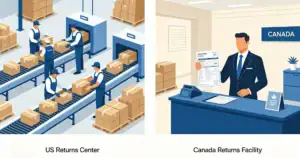
Lots of dedicated returns processing centers that can inspect, repack, refurbish, liquidate, or dispose of returned items.
-
Costs are fairly low. For example, processing one return (inspection + restocking) is quite affordable.
-
There are even “returns pooling” services where sellers combine returns and ship them to Mexico or Asia for low-cost repairs.
In Canada:
-
Fewer reverse logistics providers, mostly in the greater Toronto or Vancouver areas.
-
Costs are noticeably higher. The same returns process often costs much more than in the U.S., and that doesn’t even include local pickup fees.
-
Because of this, many sellers just refund customers and let them keep the item (especially for low-priced products), which eats into profits.
Solutions:
-
For higher-value items (like electronics or tools), work with a local Canadian returns hub. AMZ SHIPPER partners with a Toronto-area warehouse where returns are sorted and graded—repairable items go to local repair shops, non-repairable ones are either sent back to the U.S. in bulk or sold off locally B2B.
-
Prevention is better than cure. On your Canada product pages, clearly show bilingual (English/French) instructions and local certification marks. Improve packaging strength too. This can significantly lower return rates. One 3C seller we worked with cut return rates from over 7% to under 4% just by adding bilingual instructions.
6. Practical Checklist: Key Decision Points for U.S. & Canada Logistics
If you’re planning to stock goods in both the U.S. and Canada, here’s a list of things to check:
-
Check postal codes before shipping: Use Canada Post’s “Remote Area” tool to see if a destination is within the standard delivery network.
-
Estimate duties early: Use CBSA’s “Canadian Customs Tariff” for Canadian HS codes, and the HTSUS website for the U.S.
-
Monitor FBA capacity: If you sell in Canada, keep an eye on your Inventory Performance dashboard to avoid hitting storage limits.
-
Pre-screen compliance documents: Send product photos, manuals, and certificates to AMZ SHIPPER’s customs team for a quick check on Canadian entry risk.
-
Plan for winter: Every fall, buy insulated liners or freeze-resistant packaging for goods sent to Eastern Canada (some liquids, cosmetics, or gels can freeze or spoil at very low temperatures).
-
Simulate return costs: Calculate expected losses for the U.S. and Canada using “price × return rate × returns handling cost.” If the Canada number exceeds a certain percentage of your margin, prioritize better product instructions and packaging.

ABout AMZ Shipper
AMZ Shipper has several years of experience for international logistics Freight Forwarding service. Our service is for importer and exporter, foreign freight forwarders, local and abroad business. Export of 1500 of 40HQ per year for FBA Amazon shipping, 15-30tons of air shipments per month.
Member of WCA. Our company is a professional Amazon freight forwarder that specializes in providing comprehensive and efficient services to customers.