For Amazon sellers, cross-border trade in 2026 comes with a clear reality: tariff rules and customs compliance requirements are changing more often, and each change can directly eat into profits or mess up restocking schedules. From the U.S. tightening reviews on low-value packages, to the EU expanding its carbon tariff pilot categories, to several Southeast […]
For Amazon sellers, cross-border trade in 2026 comes with a clear reality: tariff rules and customs compliance requirements are changing more often, and each change can directly eat into profits or mess up restocking schedules. From the U.S. tightening reviews on low-value packages, to the EU expanding its carbon tariff pilot categories, to several Southeast Asian countries tightening their rules of origin — these shifts are no longer “black swans.” They’re just new variables you have to plan for.
That’s why supply chain resilience is no longer just for the big players. Any seller using FBA or direct-to-consumer shipping needs to build it. Resilience isn’t about hoarding inventory. It’s about keeping reasonable stock levels and cost control even when tariffs shift, customs gets delayed, or shipping routes change.
Below are three foreseeable policy trends for 2026, followed by four practical strategies to help you build that resilience.
1. Three Trade Policy Trends That Could Affect Amazon Sellers in 2026
These trends are based on publicly announced legislative timelines or discussion papers. No political predictions here — just operational food for thought.
Policy Trend Area
Main Regions Affected
Possible Timing
Direct Impact on Amazon Sellers
Lower threshold for low-value package duty exemption
U.S., EU, Brazil
U.S. (discussion in Q2 2026), EU (2026–2027 gradual)
Higher cost per small package; profits disappear on low-price items (under $20)
Stricter rules of origin checks
U.S., Vietnam, Mexico
Throughout 2026, gradually ramping up
More paperwork needed; higher inspection rates; longer customs clearance
Environmental fees and carbon tariff pilots
EU (CBAM), UK, Japan
EU CBAM expands to more product categories (2026)
Some industrial goods, textiles, and batteries need carbon emission declarations; possible extra fees
Note: All of these policies are still moving through legislative or administrative processes. Final rules may change. Keep an eye on official announcements — don’t panic and overstock.
Infographic of three key 2026 trade policy trends affecting global e-commerce
1.1 Lower threshold for low-value package duty exemption
Several countries are rethinking their “de minimis” rules. The U.S., for example, has already removed some textile products from duty-free treatment and is discussing lowering the current 800 threshold. If that happens, small packages valued at 100–200 could face a 5–$10 processing fee plus duties per shipment.
Categories hit hardest: Apparel, accessories, small home goods, electronics accessories, beauty tools — basically any low-priced item often shipped directly to buyers.
What you can do: Move some of your inventory from direct shipping to local warehouses or FBA in your target market. Ship in bulk by sea and use local delivery to avoid per-package customs costs.
1.2 Stricter rules of origin checks
U.S. Customs and Border Protection stepped up its scrutiny of transshipment through third countries back in 2025. In 2026, Vietnam, Mexico, Malaysia, and other transit hubs will also tighten their rules of origin certifications. If you’re just doing simple repackaging or final assembly in a third country, you won’t get that country’s certificate of origin anymore.
A common risky move: Made in China → shipped to Vietnam for relabeling and light assembly → exported to the U.S. as “Made in Vietnam” → customs catches it → you owe back anti-dumping duties or extra tariffs.
What you can do: Keep solid documentation of your actual production steps. Or if you want real risk reduction, move some actual production steps to another country — not just paperwork.
Supply chain dashboard visualizing multi-country production and risk metrics.
1.3 Environmental fees and carbon tariff pilots
The EU’s Carbon Border Adjustment Mechanism already covers steel, aluminum, cement, electricity, fertilizer, and hydrogen. By 2026, it may expand to organic chemicals and plastic products. Even if your product category isn’t directly covered yet, some European buyers are already asking suppliers for product carbon footprint data before they’ll place orders.
How this hits you: It’s not a direct tariff, but when you clear customs you may need to declare embedded carbon emissions. Without credible data, customs might apply a default high carbon intensity rate — which can get expensive.
What you can do: Choose shipping options with lower carbon output. Start tracking emissions from your first-mile transport (sea freight produces about 40–60 times less CO2 than air freight).
2. Four Practical Strategies to Build Supply Chain Resilience
These strategies don’t rely on guessing what any specific country will do. They’re about building physical networks and processes you can actually switch around when needed.
Strategy 1: Multi-node warehousing — get closer to buyers and farther from tariff trouble
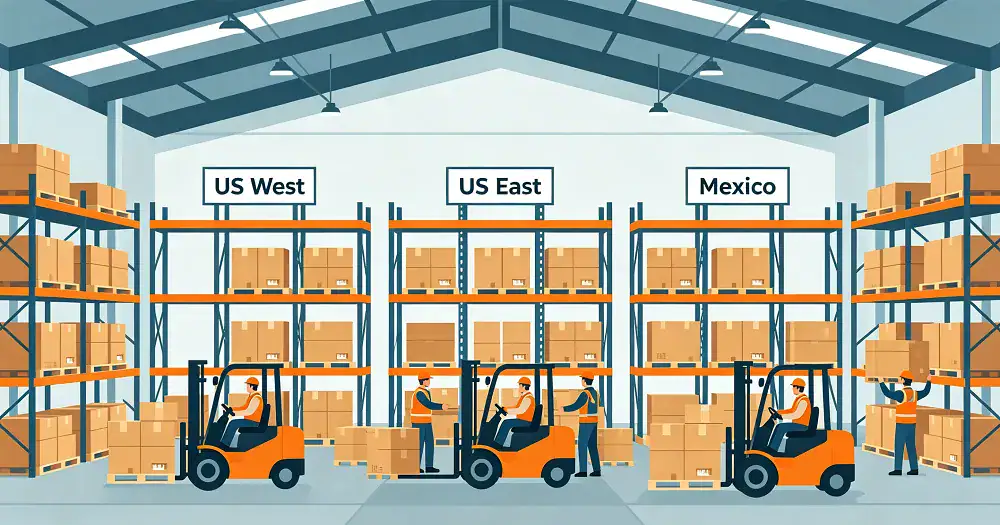
Core idea: Spread your inventory across 2–3 warehouse locations in your main sales regions (for example: West Coast U.S., East Coast U.S., and Mexico or Canada). If one location runs into tariff issues or customs backups, you can pull from another.
Specific steps:
Find logistics partners that have warehousing in China, the U.S., Europe, and Japan.
Sort your SKUs into three buckets based on sales data:
High-turnover core items → position in target market warehouses
Slow-moving, low-demand items → keep in China
Seasonal items → ship to overseas warehouses 2–3 months ahead in batches
Run a quarterly drill: “What if this port closes?” or “What if this country adds a tariff?”
The catch: More warehouse nodes means about 15–25% higher total inventory levels, which ties up cash. Start with one or two target markets where you do the most volume, rather than trying to do everything at once.
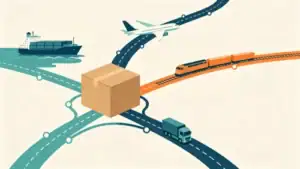
Strategy 2: Dynamic route switching — give your logistics a Plan B
Core idea: Don’t lock yourself into one port or one shipping lane. When your main route (say, China to LA/Long Beach) runs into delays from policy changes or extra inspections, you should be able to switch to a backup route (like China to Vancouver, then rail to the U.S. Midwest, or China to Houston).
Specific steps:
When choosing a logistics provider, ask them to share at least two backup route options with estimated transit times and costs.
For higher-value products, try sea-air intermodal transport(sea freight from China to Korea or Vietnam, then air freight to Europe or the U.S.). It costs a bit more, but it can bypass serious customs backlogs in certain countries.
Make a “policy response checklist.” As soon as you see an official announcement that a country plans to tighten inspections on your product category, switch your next shipment to a backup port.
Policy response examples
Trigger (based on public policy signals)
Switch action
Estimated cost increase
Best for product types
U.S. launches anti-dumping investigation on a category
Route through Vancouver (Canada), then truck/rail to U.S. Midwest
+5–8% freight cost
Furniture, aluminum products, some machinery parts
An EU member state starts strict low-value checks
Route through Rotterdam or Antwerp; use advance customs filing
+2–3% customs admin fee
Shoes, clothing, consumer electronics
A Southeast Asian country tightens rules of origin
Split final assembly across two or more countries
+10–15% production cost
Textiles, solar components
A heads-up: Switching routes requires your logistics partner to actually operate in multiple ports. Your customs paperwork also needs to match the backup port’s requirements. Run a test shipment on your backup route during calm periods, not when you’re already in crisis mode.
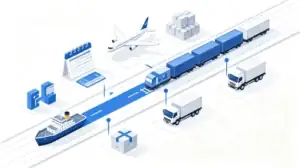
Multi-node warehousing system with inventory distributed across regional hubs
Strategy 3: Spread out your suppliers — don’t put all production in one country
Core idea: Moving all production to another country isn’t realistic for most sellers. But you can shift 10–20% of your regular SKUs to a third-country supplier (Indonesia, Mexico, Turkey, etc.) and run 1–2 small container trials per month. This lowers your tariff policy risk and gives you leverage with your main supplier.
Specific steps:
Pick a candidate country that’s in a similar time zone to China and already has a light manufacturing base (e.g., southern Vietnam, Java in Indonesia, Monterrey in Mexico).
First-year goal: Move about 15% of the order volume for 2–3 low-complexity SKUs to the backup supplier.
Use the same logistics provider for both your China production and your third-country production. It makes tracking and comparing customs clearance much easier.
Watch out: Don’t spread production just for the sake of it. Third-country suppliers often quote 10–25% higher than China, and their labor productivity is usually lower. This works best for policy-sensitive, higher-value products with less tariff flexibility.
A common mistake: Thinking you can just swap labels to avoid tariffs. In 2026, customs will be using fiber analysis and chemical testing to verify actual origin. Simple label swaps are high-risk and not worth it.
Strategy 4: Tariff cost hedging tools — use legal customs programs to manage cash flow
Core idea: Tariffs don’t always have to be paid right away at full value. There are legal customs programs that let you delay payment or reduce the taxable value.
Specific tools:
U.S. Foreign Trade Zone: When your goods enter an FTZ, you don’t pay tariffs immediately. You pay when the goods leave the zone and enter the U.S. market. Great for seasonal stocking or products that need further processing.
Bonded warehousing (EU/UK): Keep goods in a bonded warehouse for up to 2 years. Clear them in batches, so you don’t pay a huge tariff bill all at once.
First Sale Rule: If you import through an intermediary, you can declare based on the price the manufacturer sold to the intermediary (not the price the intermediary sold to you). This can lower your tariff base.
The boundaries: These tools require working with a professional customs broker, and you need clean, complete transaction records. Don’t even think about faking prices.
Cost hedging comparison
Hedging tool
Best for
Tariff payment delay
What you need
Risk level
U.S. Foreign Trade Zone
Large shipments that enter Amazon gradually
3–12 months
FTZ access permit
Low
EU bonded warehouse
Seasonal items, testing new products
2–24 months
Warehouse rental + regular inventory checks
Low
First Sale Rule
Sellers who import through an intermediary/buying office
Practical advice: For most Amazon sellers, the Foreign Trade Zone and bonded warehouse are the easiest to try first. The First Sale Rule is more complex — consider it only if your annual logistics spend is over $500,000.
Conceptual illustration of a robust and resilient global supply chain network
ABout AMZ Shipper
AMZ Shipper has several years of experience for international logistics Freight Forwarding service. Our service is for importer and exporter, foreign freight forwarders, local and abroad business. Export of 1500 of 40HQ per year for FBA Amazon shipping, 15-30tons of air shipments per month.
Member of WCA. Our company is a professional Amazon freight forwarder that specializes in providing comprehensive and efficient services to customers.