Every Amazon FBA seller knows the classic dilemma: send too much stock and you are choked by storage fees; send too little and you run out of stock, watching your rankings plummet. On top of that, there is an even bigger variable – ocean freight. It is cheap but slow; air freight is fast but expensive. How do you choose? How much do you order? When should you replenish? Behind these questions lies a complex calculation of cost and risk.
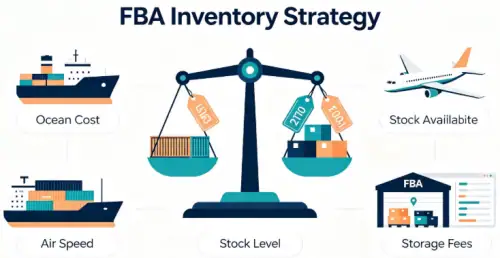
This article walks you through four key areas: order quantity decisions, replenishment timing, transport mode selection, and risk hedging. The goal is to help Amazon sellers build a strategy that balances ocean freight costs with stock availability.
The Two Sides of Ocean Freight: What Amazon Sellers Must See
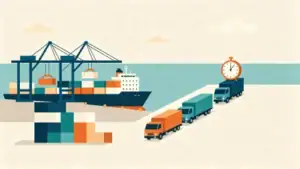
Most Amazon sellers choose ocean freight for one simple reason: it saves money. Compared to air freight, the per‑kilogram rate for ocean shipping is significantly lower, making it the most economical option for bulky or heavy products.
But the “cheapness” of ocean freight comes at a price – time. From major Chinese ports to the US West Coast, ocean transit usually takes 30 to 45 days; to the East Coast or Europe, it takes even longer. That month‑plus in transit means your inventory turnover cycle stretches out considerably.
Worse, ocean freight is unpredictable. Schedule delays, port congestion, customs inspections – any of these can turn a “30‑day arrival” into 45 or even 60 days. For Amazon sellers already running lean on inventory, that uncertainty can be fatal.
So when planning your FBA inventory strategy, you cannot look only at the per‑kilogram freight rate. You have to factor in the risk of stock‑outs and the cost of capital tied up in transit. A seemingly cost‑saving ocean shipment that gets delayed might end up costing you far more in lost rankings and advertising spend than the freight savings you gained.
Order Quantity: How Much to Send and the Economics of Ocean Freight
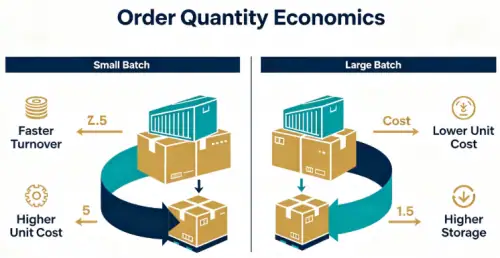
Order quantity is the most basic variable in your FBA inventory strategy. Ship less, and you turn over quickly but risk stock‑outs; ship more, and you feel safer but pay higher storage fees and tie up more cash.
With a small‑batch, high‑frequency approach, the per‑kilogram ocean freight rate tends to be higher (because consolidation and documentation costs are spread over fewer units), and you pay those fixed charges repeatedly. The upside is faster turnover, lower capital lock‑up, and less storage cost.
With a large‑batch, low‑frequency approach, the per‑kilogram ocean freight cost is diluted (full containers have the lowest unit cost), but you tie up a lot of working capital, and storage fees rise as inventory days increase.
For Amazon sellers, there is another constraint – FBA storage limits. Amazon caps each seller’s inventory capacity, and exceeding that means either being blocked from sending more or paying hefty overage fees. So you cannot just ship massive quantities indefinitely to lower your ocean freight unit cost.
A practical rule of thumb: ship best‑sellers in bulk via ocean freight because they turn fast, storage fees stay manageable, and the cost of a stock‑out is high. For new or test products, start small – use faster (though more expensive) modes like air freight to gauge market response, then switch to ocean freight for larger replenishments once you confirm demand.
Replenishment Rhythm: Timing Your Ocean Freight Shipments to Avoid the “Long Tail”
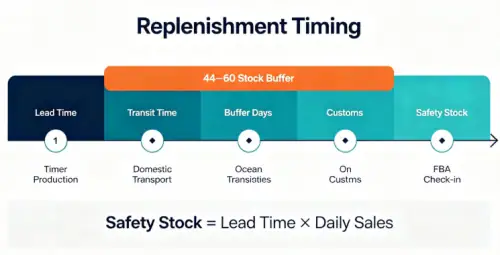
Another critical variable in ocean freight is time – from placing an order to having goods on FBA shelves typically takes 45 to 60 days (including production, domestic transport, international shipping, customs clearance, and FBA check‑in). This “long tail” has tripped up many Amazon sellers.
The core of replenishment rhythm is safety stock. A common formula is:
-
Safety stock = (lead time + transit time + buffer days) × average daily sales
With ocean freight, it is wise to add at least 10‑15 extra buffer days to account for schedule delays, port congestion, and other uncertainties.
A common mistake is “chasing demand” – when sales suddenly rise, sellers rush to order more, only to find that the next ocean vessel does not leave in time, forcing them to use expensive air freight for emergency replenishment. That spikes their shipping costs and eats into margins.
A better approach is a “tiered replenishment” rhythm:
-
Quarterly planning – estimate sales for the quarter and plan a large ocean freight shipment accordingly.
-
Monthly adjustments – update the next month’s order quantity based on actual sales data.
-
Weekly monitoring – track your inventory burn rate. If actual sales exceed projections, trigger your emergency replenishment plan immediately.
By combining long‑term planning with short‑term adjustments, Amazon sellers can keep both the cost advantage and the timing weakness of ocean freight under control.
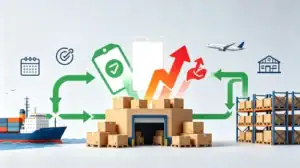
Mixing Transport Modes: The “Golden Combo” of Ocean Freight and Air
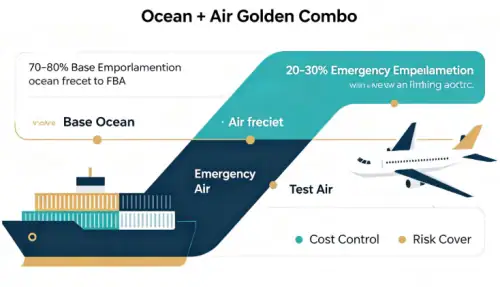
Many Amazon sellers think in binary terms – either all ocean (to save money) or all air (to go fast). But a truly mature inventory strategy usually uses a mix.
Here is a common hybrid approach:
-
Base replenishment via ocean freight – cover 70‑80% of your total volume, shipped 2‑3 months in advance, for the best cost efficiency.
-
Emergency replenishment via air freight – cover 20‑30% of your volume, used when your ocean shipment is still at sea and FBA inventory is about to run out.
-
New product testing via air freight – send a small air shipment first to test conversion, then switch to ocean freight once you confirm the product sells.
The logic is simple: use ocean freight for routine cost control, and air freight for exceptional risk coverage. Air freight costs more per kilo, but compared to the lost ranking and sales from a stock‑out, that premium is often well worth it.
One detail often overlooked – different service levels within ocean freight. Fast vessels (like Matson’s regular service) and standard vessels (such as EMC, COSCO, etc.) differ significantly in both transit time and cost. Fast ships take about 12‑16 days to port, while standard ones may take 25‑35 days. Amazon sellers can further segment their ocean freight choices based on urgency – not urgent enough for air but still time‑sensitive? Go with a fast vessel. No rush at all? Standard vessel it is.
Risk Management in Ocean Freight: The Last Line of Defence for Stock Availability
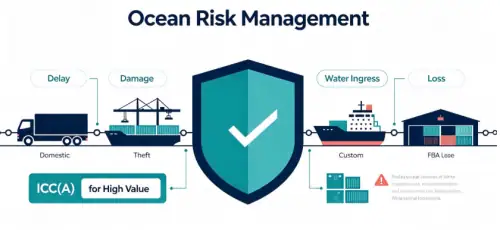
The biggest risk of ocean freight’s “slowness” and uncertainty is that your FBA warehouse runs dry while your goods are still on the water. But there is an even more hidden risk – something goes wrong with the cargo itself.
The ocean freight chain is extremely long – domestic trucking, terminal handling, sea voyage, destination customs, and FBA delivery. Problems can crop up at any link: container water ingress, vessel collision, theft, mishandling – these are real risks in ocean freight.
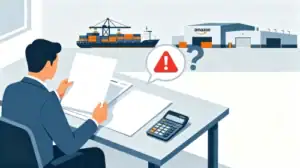
Many Amazon sellers only calculate their inventory under “normal” conditions, ignoring the “abnormal” losses. If an ocean freight shipment suffers damage or loss in transit, you lose not just the cost of those goods but also the time window to reorder – producing and shipping again takes another 45‑60 days. During that period, your listing may be out of stock for weeks, rankings drop sharply, and you may lose the Buy Box.
For high‑value Amazon sellers, ocean freight shipments should be covered by comprehensive cargo insurance (e.g., ICC(A) All Risks). The premium is a small percentage of the cargo value, but it converts an unpredictable total‑loss risk into a fixed, manageable cost.
For mid‑to‑low value sellers, you may not need the highest coverage, but you should at least understand this: the carrier’s liability for ocean freight is extremely limited – under international maritime rules, compensation is capped per package or per kilogram, far below the actual value of most FBA goods. Do not assume “the carrier will pay” – under ocean freight rules, their payout may cover only a fraction of your cargo’s worth.
| Cargo Value Type | Ocean Freight Cargo Value | Insurance Recommendation |
|---|---|---|
| High‑value | Single shipment is valuable; a loss would be severe | Consider ICC(A) All Risks, covering the full warehouse‑to‑warehouse journey |
| Mid‑value | Loss is bearable but still hurts | Consider ICC(B) Named Perils, covering major accidents |
| Low‑value | Loss is more manageable | At least know the carrier liability limits; consider ICC(C) basic cover |
Common Mistakes Amazon Sellers Make with Ocean Freight Inventory Strategies
Only looking at the per‑kilogram freight rate. Many Amazon sellers choose a logistics provider based solely on the rate per kilogram. But the total cost of ocean freight includes much more – domestic drayage, terminal handling, customs clearance fees, documentation fees, destination charges, and FBA delivery. These “hidden costs” can add up to 30‑40% of the total. Focusing only on the per‑kilo rate often leads to decisions that look cheap but end up costing more overall.
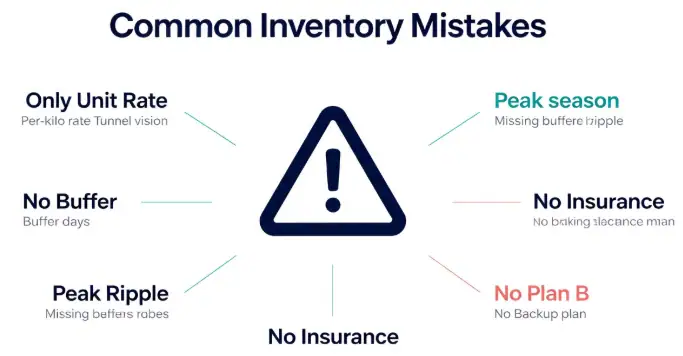
Not building enough buffer time for ocean freight. When planning replenishment, a common error is using the “theoretical minimum” transit time – if the carrier says 20 days, sellers plan for 20 days. But in reality, ocean freight faces delays, port congestion, customs inspections – any of which can turn 20 days into 30 or even 40. Always add at least 10‑15 extra buffer days to your ocean freight replenishment plan.
Underestimating the “ripple effect” of peak season. From July to October each year, ocean freight enters peak season – port congestion, rate hikes, space shortages. These factors directly hit Amazon sellers’ inventory: your goods may arrive at the destination port on time, but customs clearance and FBA check‑in can take much longer than usual. Many sellers find their ocean shipments sitting at US ports for two weeks waiting for pickup, pushing FBA availability nearly a month behind schedule.
Overlooking cargo insurance for ocean freight. As mentioned earlier, many sellers simply do not include insurance in their ocean freight inventory plan. They think “my forwarder bought it for me” – but forwarders often purchase only basic cover, not All Risks, and the coverage is extremely limited. When a claim does occur, they discover the policy exclusions leave them unprotected.
Failing to have a backup plan for ocean freight. Planning only one route – ocean freight – with no Plan B. If something goes wrong, you just wait. Mature Amazon sellers always keep an “emergency lane” in their inventory strategy – when ocean freight is delayed, they can quickly switch to air freight, even if it costs more, because it is still better than going out of stock.
As a logistics provider focused on cross‑border e‑commerce, AMZ Shipper regularly helps Amazon sellers refine their ocean freight inventory strategies – from transport mode selection and replenishment scheduling to cargo insurance – so that FBA sellers can find the optimal balance between cost and stock availability in this complex international shipping environment.
ABout AMZ Shipper
AMZ Shipper has several years of experience for international logistics Freight Forwarding service. Our service is for importer and exporter, foreign freight forwarders, local and abroad business. Export of 1500 of 40HQ per year for FBA Amazon shipping, 15-30tons of air shipments per month.
Member of WCA. Our company is a professional Amazon freight forwarder that specializes in providing comprehensive and efficient services to customers.