A few years ago, most Amazon sellers thought FBA was the only way to go. Fast forward to 2026, and the conversation has shifted. FBA is still great—don’t get me wrong—but relying on it alone is starting to feel risky.
Why? Because storage fees have become less predictable, peak season surcharges keep changing, and more sellers are realizing that putting all their inventory in Amazon’s hands leaves them with little flexibility.
That’s why multi-channel fulfillment (MCF) is no longer just for huge brands. More and more sellers—whether they make a few hundred thousand dollars a year or run multi-platform operations—are building a hybrid model: FBA + third-party overseas warehouses + direct shipping from China. This lets them serve Amazon, their own Shopify store, TikTok Shop, eBay, and even wholesale buyers, all from the same pile of inventory.
1. Four FBA Limitations That Still Bother Sellers in 2026
Amazon has tweaked its FBA policies quite a bit over the last couple of years. On the surface, the changes are meant to make warehousing more efficient. But for many sellers, the real outcome is this: costs have become harder to predict and control.
Here are four limits that still hurt in 2026.
1.1 Costs are harder to manage
FBA fees aren’t just one thing. You’ve got monthly storage fees, long-term storage fees, peak-season delivery surcharges, return processing fees, disposal fees, removal fees… the list goes on. And each of these can change by marketplace and by season.

The frustrating part? A few slow-moving SKUs can quietly eat up the profits from your best sellers. And if you try to remove or dispose of that slow stock, that costs money too.
Who feels this the most?
-
Sellers with more than 50 SKUs
-
Seasonal product sellers (holiday decorations, summer gear)
-
Sellers of durable goods that turn over slowly
1.2 You can’t move inventory freely
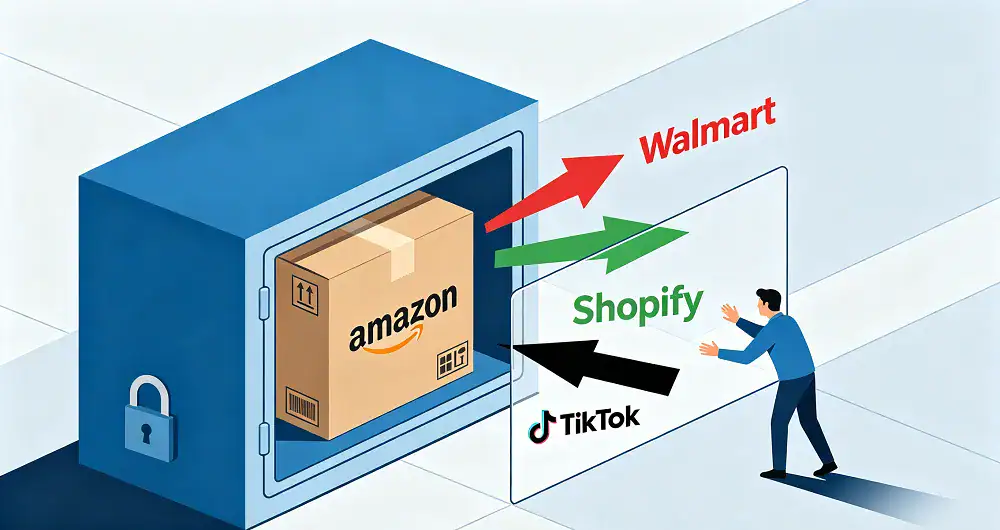
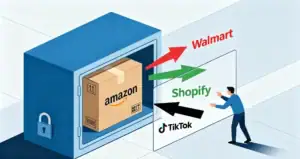
This one doesn’t get talked about enough. Once your goods are inside an FBA warehouse, they’re basically locked in with Amazon.
Want to pull some units to fulfill a Walmart order? Or send stock to your own website for a flash sale? Or supply a wholesale buyer? There’s no easy button. The usual workaround is to create a removal order, wait weeks for Amazon to process it, then ship the goods again to wherever you actually need them. That means extra fees and lost time.
Common headaches:
-
Your independent site suddenly goes viral, but FBA inventory can’t be touched
-
You want to run a Walmart promotion but don’t want to double your inventory investment
-
You’re testing a new product on TikTok Live, but don’t want an “out of stock” badge on Amazon
1.3 Category restrictions are still tight
Amazon has eased up on some items, sure. But in 2026, plenty of everyday products are still banned or heavily restricted by FBA.
| Restricted Category | What Amazon Typically Requires | What Sellers Do Instead |
|---|---|---|
| Lithium-ion battery products | Most batteries over a certain capacity are not allowed | Use a third-party warehouse that accepts special goods |
| Liquids, gels, powders | Strict limits on volume and packaging | Ship directly from China or use specialized storage |
| Oversized / overweight items | Items above specific length/weight limits are often rejected | Third-party warehouse with large-item shipping |
| Short-shelf-life products | Less than 90 days of remaining shelf life = not accepted | Fast-turnaround third-party + regional delivery |
For sellers in tools, beauty, auto parts, or large home goods, these restrictions mean one thing: you either leave FBA or leave out certain product lines.
1.4 Geographic reach is still limited
FBA only really works well in countries where Amazon operates a fulfillment network. If your customers are in the following places, FBA won’t help much:
-
The Middle East (patchy coverage even where Amazon has a presence)
-
Most of Latin America (Mexico is okay, but beyond that?)
-
Southeast Asia (Singapore is fine, but the rest?)
-
Africa
If you want to sell globally, this forces you to hold separate FBA inventory in multiple countries. That ties up a lot of cash.
2. Three Real Advantages of Multi-Channel Fulfillment
So why are so many sellers moving toward MCF? It comes down to three things: predictability, flexibility, and brand control.
2.1 More predictable costs
In a hybrid fulfillment setup, your costs are much simpler and more transparent. You’ve got:
-
Head haul (sea freight / air freight from China)
-
Warehousing (charged by the day or month, based on pallet space or cubic meters)
-
Pick & pack (per-order handling fee)
-
Last-mile delivery (based on actual weight and delivery zone)
What you don’t get:
-
No “long-term storage fees” just because something sat for a few months
-
Returns can come back to your warehouse for inspection and resale—not just get thrown away
-
Peak season surcharges are usually smaller and simpler than Amazon’s
A quick comparison (no dollar amounts, just structure):
| Cost Component | Pure FBA | Hybrid (FBA + 3PL) |
|---|---|---|
| Inbound prep | Strict: labels, pallets, appointments required | Flexible: bulk drop-off or LTL accepted |
| Monthly storage | Per cubic foot, complicated tiers | Per pallet or CBM, simple and clear |
| Long-term storage | Extra fees after a certain period | No such thing |
| Per-order delivery | Fixed rates by size/weight | Actual weight + zone, multiple carrier options |
| Return handling | High disposal rate, hard to restock | Can inspect, repack, relabel, and resell |
| Multi-channel support | Only for Amazon orders (MCF exists but costs more) | One inventory pool serves all channels |
The Advantages of Shipping to Multiple Channels from a Single Inventory Pool
2.2 One inventory pool for all your sales channels
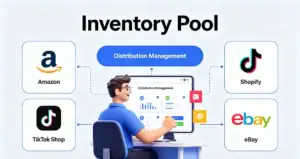
This is the real magic of MCF. Instead of splitting your stock across Amazon, your own warehouse, Walmart’s system, and so on, you keep most of it in one or two third-party warehouses. From there:
-
Amazon orders → fulfilled via Amazon’s MCF program or directly from the 3PL
-
Shopify / WooCommerce → API pulls the order, same warehouse ships it, with your own packaging
-
eBay / Walmart / TikTok Shop → same inventory, same process
-
Wholesale buyers → bulk ship directly from the warehouse
What this means in practice:
-
Less total inventory tied up across different platforms
-
No more “out of stock on Amazon but plenty sitting in my own garage”
-
Better negotiating power on shipping and freight
2.3 Full control over your brand experience
When you use FBA, your customer gets a box with Amazon’s logo, an Amazon packing slip, and no way for you to say thank you or offer a discount on their next order.
With a third-party warehouse:
-
✅ You can use custom boxes, branded tape, and nice filler materials
-
✅ You can include a thank-you card, a discount code, or a new product flyer
-
✅ Returns come back to your warehouse, so you can inspect, repack, and resell—instead of just losing the product
For sellers who want to build a real brand—not just sell on Amazon—this can have a huge impact on repeat purchase rates.

3. Four Steps to Build Your Own Hybrid Fulfillment Strategy
You don’t need a huge budget or a custom system to get started. Here’s a simple framework that works for most sellers doing $500k+ per year.
Step 1: Split your products by what stays in FBA
Not everything should leave FBA. A smart split looks like this:
| Product Type | Keep in FBA? | Why |
|---|---|---|
| Best sellers with steady daily volume | Yes | Prime badge is still powerful for conversion |
| Mid-tier products (3–15 units/week) | No → move to 3PL | Avoid long-term storage fees, lower unit cost |
| Oversized / heavy items | No | FBA charges a lot for large items and often restricts inbound |
| Batteries, liquids, powders | No | FBA mostly bans these; use a specialized 3PL |
| DTC / brand site orders | No | You need branded packaging and flexible returns |
| New test products | No | Avoid FBA removal costs if the product flops |

Step 2: Spread your inventory across locations
A smart 2026 warehouse setup has a few layers:
-
China consolidation hub (Shenzhen, Guangzhou, Yiwu): Receives goods, does labeling, handles export customs, and can ship small parcels directly or send bulk to overseas warehouses. AMZ Shipper offers this type of service.
-
In-country core warehouses (Los Angeles, New Jersey/Atlanta, Frankfurt, Tokyo, etc.): Your main third-party inventory hub. Choose locations near large populations and transport hubs.
-
FBA-only buffer stock: Just enough of your top 1–2 best sellers to keep the Prime badge. Don’t stuff everything into FBA.
Why this helps: If an FBA warehouse limits inbound, or your main 3PL gets backlogged, or a shipping lane gets delayed, you can quickly switch fulfillment sources and avoid stockouts.
Step 3: Connect your systems
Manually managing orders from Amazon, your own site, TikTok, and eBay is a mess. In 2026, there are plenty of affordable tools that do this for you:
-
OMS (Order Management System) like ShipStation or Zentail: pulls orders from all your channels into one dashboard
-
WMS (Warehouse Management System): most third-party warehouses already run one, and can sync inventory levels in real time
-
Direct API: larger sellers can connect their own ERP directly to a logistics provider like AMZ Shipper
Key feature to look for: The system should let you set routing rules—like “when FBA inventory drops below X units, automatically fulfill the next orders from my 3PL.”
Step 4: Build a risk buffer
This step sounds boring, but it’s the one that saves your business when something goes wrong.
Things to set up in advance:
-
An active account with a reliable 3PL (like AMZ Shipper)
-
A small safety stock in that 3PL’s warehouse—enough to cover 1–2 weeks of sales
-
A clear written procedure for switching from “FBA fulfillment” to “3PL fulfillment” in under 30 minutes
When will you need this?
-
Amazon temporarily freezes or audits your account
-
An FBA warehouse stops accepting inbound due to weather, backlog, or policy change
-
One of your products gets wrongly flagged as a restricted item
-
Amazon suddenly limits replenishment right before peak season
In any of these situations, having a backup fulfillment option is like an insurance policy for your revenue.
4. How AMZ Shipper Fits Into a Hybrid Fulfillment Setup
AMZ Shipper isn’t trying to replace FBA. Instead, the company positions itself as a complementary logistics partner for sellers who want to sell across multiple channels.
Based on its website and service offerings, here’s what stands out for sellers building a hybrid strategy:
-
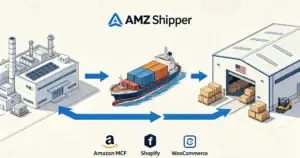
China warehouse network – Pickup points in Shenzhen, Guangzhou, Yiwu, and other major export cities. You can consolidate goods there before shipping to the US, Europe, or Japan, whether the final destination is FBA or your own 3PL.
-
Flexible head haul options – Full container, LCL, air freight, or express. You choose based on your product size, urgency, and cost priorities.
-
Overseas fulfillment – Partner warehouses in destination countries support everything from single orders to bulk shipments. They can handle Amazon orders, DTC orders, and marketplace orders all from the same stock.
-
Special goods handling – For products FBA restricts (batteries, liquids, cosmetics, etc.), they have dedicated logistics routes.
-
Platform integration – Their system can connect with Amazon MCF, Shopify, WooCommerce, and others for automated order pulling and inventory syncing.
-
Personalized approach – As their site says, every shipment is unique. They offer custom inventory and warehousing plans based on your actual sales patterns, not one-size-fits-all packages.
ABout AMZ Shipper
AMZ Shipper has several years of experience for international logistics Freight Forwarding service. Our service is for importer and exporter, foreign freight forwarders, local and abroad business. Export of 1500 of 40HQ per year for FBA Amazon shipping, 15-30tons of air shipments per month.
Member of WCA. Our company is a professional Amazon freight forwarder that specializes in providing comprehensive and efficient services to customers.