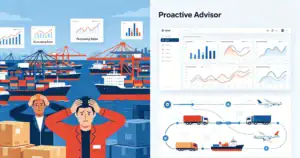
Over the past few years, supply chains have faced real challenges—port congestion, rate swings, and unstable shipping schedules. For Chinese exporters and cross-border e-commerce sellers, that kind of uncertainty directly leads to piled-up inventory, stockout risks, and thinner profits. Traditional freight forwarders tend to inform customers only after something goes wrong. But AI-powered predictive analytics is changing that. It’s helping forwarders shift from being “reactive problem-solvers” to “proactive advisors.”
This article breaks down four key areas where predictive analytics is transforming freight forwarding: transit time, freight rates, operational disruptions, and warehouse inventory management.
1. What Is Predictive Analytics in Freight Forwarding?
Unlike traditional methods that rely on fixed spreadsheets and gut feeling, predictive analytics uses machine learning models to process large amounts of historical and real-time data. It forecasts supply chain events that might happen in the next 3 to 30 days. The data typically includes:
-
Historical business data – past port congestion cycles, space utilization on certain routes, and seasonal customs clearance times
-
Real-time operational data – vessel positions via AIS, port queue lengths, local weather alerts, and customs inspection rates
-
Related market data – fuel price trends and carrier blank sailing plans
With all this data, AI models can produce probability-based predictions. For example: “The average transit time from Shanghai to Los Angeles will likely increase by 4 days in the next two weeks, with 78% confidence.” That level of detail is exactly what forwarders and shippers need to make better decisions.
2. Four Key Scenarios Where Predictive Analytics Reshapes Supply Chains
These four use cases are already being applied in freight forwarding, and each brings clear value to customers. Every scenario includes a real-life example from AMZ Shipper.
Scenario 1: Transit Time Predictions – From Static to Dynamic ETA
Traditional ETAs on a bill of lading barely get updated after departure. That makes it hard for sellers to plan FBA shipments or production schedules. Predictive analytics offers a dynamic ETA that updates daily based on vessel speed, upcoming port queues, weather, and other factors.
| Traditional Approach | AI-Powered Approach |
|---|---|
| A fixed date given after departure | Daily updated remaining days + confidence range |
| Customers notified after a delay happens | 72-hour early warning of delay probability + alternative options |
| Can’t separate port delays from trucking delays | Predicts ocean segment and inland trucking separately |
Real example from AMZ Shipper:
A Ningbo exporter was shipping goods to a warehouse in the U.S. Midwest. Right after departure from Qingdao, the AI model predicted that due to seasonal canal restrictions and higher terminal volume at the discharge port, the shipment would arrive 6 days later than the original ETA. The system alerted the customer in advance, allowing them to adjust their warehouse replenishment plan and avoid an out-of-stock situation.

Scenario 2: Rate & Space Prediction – Finding the Right Booking Window
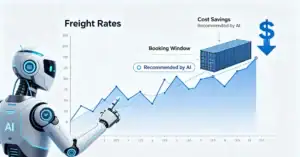
When freight rates fluctuate, delaying your booking by just a week could mean paying hundreds or even thousands more per 40-foot container. AI models analyze carrier revenue management strategies, historical rate trends, and idle vessel capacity to forecast rate movements over the next 2–4 weeks and space availability levels.
Key outputs from the model include:
-
Probability of rate increase or decrease for a given route next week (e.g., 65% chance of a 12% increase, 25% chance of no change)
-
Space availability forecast for a specific carrier route over the next 7 days (automatically alerts when it drops below 30%)
-
Recommended “latest safe booking date” based on the customer’s shipping history
-
Rate difference predictions between alternative origin ports to the same destination
For a forwarder like AMZ Shipper, which has multiple warehouses in China, the system can also suggest splitting inventory. If the model predicts tight space on a major route, it can advise moving some goods to another origin port warehouse to take advantage of available space there.
Scenario 3: Operational Disruption Warnings – From “After It Happens” to “Before It Happens”
Various operational issues can pop up in supply chains: typhoons temporarily closing ports, carriers making sudden schedule changes, or short-term spikes in customs inspection rates. AI predictive analytics pulls together carrier notices, port operations data, and weather forecasts to build a risk heat map.
| Type of Disruption | Traditional Discovery | AI-Powered Warning (Lead Time) |
|---|---|---|
| Typhoon affecting port operations | After official suspension notice | 48–72 hours ahead using weather models + port thresholds |
| Sudden carrier blank sailing | After carrier’s public announcement | 5–7 days ahead by analyzing historical patterns and booking speed |
| Port congestion getting worse | After vessel arrives and waits | Real-time calculation from queue length changes and berth productivity |
AMZ Shipper’s 24/7 support team works closely with the AI alert system. When the model predicts a high chance of efficiency dropping at a major European port in the coming week, the team proactively reaches out to affected customers and suggests alternative nearby ports or route adjustments.

Scenario 4: Warehouse & Inventory Optimization – Bridging First Mile and Last Mile
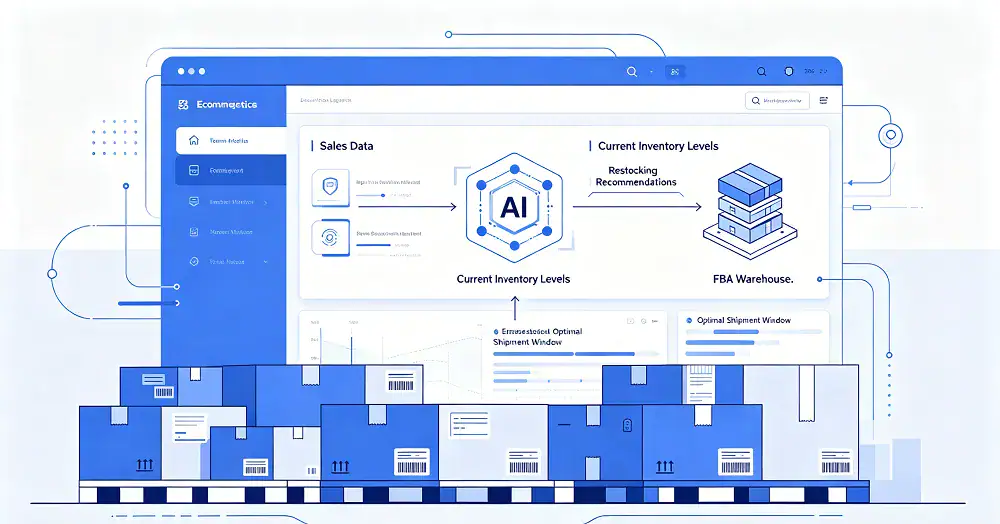
For e-commerce sellers, how long goods sit in a domestic warehouse (like AMZ Shipper’s warehouses in China) and when to restock overseas or into FBA directly affects cash flow and final delivery costs. Predictive analytics combines sales data, current inventory levels, and first-mile transit time forecasts to generate restocking recommendations.
Typical outputs include:
-
Recommended safety stock days – adjusted to the volatility of dynamic ETA to avoid overstocking or stockouts
-
Optimal shipment window – e.g., “ship within the next 10 days to avoid the peak season backlog at the destination port”
-
Warehouse allocation suggestions – which SKUs are better stored in Shenzhen (near Yantian) vs. Yiwu (near Ningbo)
-
LCL consolidation advice – combining smaller shipments from different customers to improve container utilization and lower per-kg costs
-
Multi-mode transport recommendations – when ocean volatility rises, suggest whether switching to a faster vessel service or air freight makes sense
Real example:
A seller on Amazon sells products with clear promotional cycles. The AI model predicted that discharge wait times at a certain U.S. East Coast port would rise significantly in the second week of October. At the same time, the seller’s backend showed a strong sales increase for the next month. The system automatically calculated that the goods should leave AMZ Shipper’s Guangzhou warehouse by September 20, taking a U.S. West Coast fast vessel plus rail联运 route, avoiding the long wait at the direct East Coast destination.

3. How AMZ Shipper Actually Uses Predictive Analytics
None of this is just theory. With years of experience moving thousands of containers per year, covering multiple country lanes, and working with a network of reliable partners through live API connections, AMZ Shipper has integrated predictive analytics into daily operations.
Here are the core data sources our AI prediction model uses:
| Data Type | Specific Content | Prediction Use |
|---|---|---|
| Internal operational data | Booking confirmation rates, actual carrier cut-off times, warehouse handling times in China | Train space forecast and warehouse turnover models |
| Real-time tracking data | Vessel positions and customs status codes via 200+ carrier/trucking APIs | Generate dynamic ETA and operational alerts |
| External event data | Port efficiency history, typhoon paths, fuel price indices | Build risk heat maps and rate forecasts |
| Customer behavior data | Seasonal shipping patterns, preferred routes | Provide customized restocking suggestions and space allocation |
How AI alerts work alongside our current service:
-
When the model predicts a higher risk of delays on a route, the system automatically emails and texts the affected customers. At the same time, it pushes the alert to AMZ Shipper’s customer support team for follow-up in multiple languages.
-
Customers don’t need to read complex dashboards. They just tell us their product type, destination, and expected arrival window, and our team provides an AI-generated report with alternative route options and quotes.
-
For regular customers, the model learns their unique shipping patterns and preferences—for example, “this customer ships every Friday to Germany and prefers direct sailings.” That way, the alerts and recommendations better fit their actual operations.

ABout AMZ Shipper
AMZ Shipper has several years of experience for international logistics Freight Forwarding service. Our service is for importer and exporter, foreign freight forwarders, local and abroad business. Export of 1500 of 40HQ per year for FBA Amazon shipping, 15-30tons of air shipments per month.
Member of WCA. Our company is a professional Amazon freight forwarder that specializes in providing comprehensive and efficient services to customers.