“I’m just getting started with Amazon FBA. Every time I prepare a shipment, it’s just a few cartons. Air freight is too expensive, but I can’t fill an entire container either. What should I do?”
This is one of the first logistics headaches many small Amazon sellers run into. And you’re not alone. In fact, most sellers—especially those testing new products, stocking up for seasonal sales, or placing smaller replenishment orders—face the exact same problem.
The solution? LCL shipping.
1. What exactly is LCL shipping?
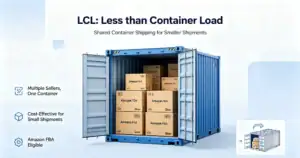
LCL stands for Less than Container Load. Think of it as carpooling—but with shipping containers.
A standard 20-foot container holds about 28–30 cubic meters. If you only have 2, 5, or even 10 cubic meters of goods, you can’t fill a whole container. That’s where LCL steps in. Your freight forwarder will combine your goods with those of other sellers into one container, ship them to the same destination port (like Long Beach or New York), and then separate and deliver each shipment to its designated FBA warehouse.
How pricing works:
-
FCL (Full Container Load): You pay a flat rate for the entire container.
-
LCL: You pay only for the cubic meters (CBM) you use. Minimum charge usually starts at 1 CBM.
The basic LCL process
LCL may sound more complicated than FCL because of the extra “mixing” and “separating” steps. But a good freight forwarder will wrap everything into a simple door-to-door service. Here’s how a typical China-to-US LCL shipment works:
-
You send your goods to the forwarder’s consolidation warehouse in China (or they pick it up from you).
-
The warehouse loads multiple sellers’ goods into one container and handles export customs clearance.
-
The container goes on a vessel—about 12–20 days to the US (depending on West Coast or East Coast).
-
At the destination port, the container is moved to a deconsolidation warehouse, where goods are sorted by seller.
-
The forwarder’s local agent completes customs clearance at destination.
-
The goods are delivered to FBA warehouses or your own overseas warehouse.
All you need to do is send your products to the China warehouse and provide the required documents. The forwarder takes care of the rest.
2. LCL vs. Air vs. FCL: Pros and cons at a glance
Here’s a quick comparison to help you decide:
| Aspect | LCL | Air Freight | FCL |
|---|---|---|---|
| Pricing | Per CBM | Per KG | Per container (20GP/40HQ) |
| Cost level | Medium (about 40–60% of air freight) | High | Low (per CBM) |
| Transit time | Slow (20–35 days door to door) | Fast (5–10 days) | Medium (18–30 days) |
| Best for | 1–15 CBM | Any volume (small items) | >15 CBM or full containers |
| Minimum volume | Usually 1 CBM | None | One full container |
| Inventory risk | Low | Very low | High (you commit to large stock) |
| Special risk | Potential delay if others’ cargo is inspected | Occasional delays due to capacity | Low (separate customs clearance) |
A couple of drawbacks to keep in mind
LCL has two main downsides compared to FCL:
-
Higher per-unit cost – Because of the extra handling (consolidation and deconsolidation), you’ll pay a bit more per CBM than you would with a full container.
-
Delay risk – If another seller’s goods in the same container get flagged by US Customs, the whole container can be held up, delaying your shipment too. This happens occasionally during peak seasons.
A good forwarder will reduce this risk by carefully choosing partners and managing customs processes properly.

3. When should Amazon sellers use LCL? 6 real scenarios
✅ Scenario 1: Testing a new product with unknown demand
This is the #1 reason to use LCL.
Say you have a new product and want to send just 100 units to FBA to test the market. Those 100 units might take up only 2–3 CBM. Air freight would eat most of your margin. A full container would tie up too much cash and rack up storage fees.
Smart move: Ship those first 2–3 CBM via LCL. If the product flops, you haven’t lost much. If it takes off, you can follow up with air freight for urgent restocks or a full container for the next batch.
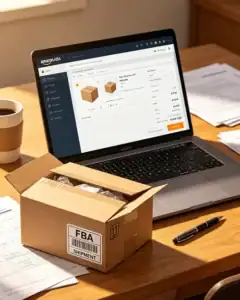
✅ Scenario 2: Routine restocking when you have 2–3 weeks of inventory left
Most small sellers have an inventory turnover of 30–60 days. When your FBA stock still has about 3 weeks left, there’s no need to pay air freight prices. LCL will get your goods there just in time (typically 25–30 days) and save you 40–60% compared to air.
Example: A home goods seller moves 2,000 units (about 5 CBM) every month. They ship 5 CBM via LCL monthly, costing around 600. Air freight for the same volume, based on dimensional weight, could easily be 1,800. That’s over $14,000 saved per year.
✅ Scenario 3: Large, heavy, or bulky items
These are air freight’s worst nightmare.
-
Large furniture – A folding table can take up 0.5 CBM. Air freight would cost more than the product itself.
-
Heavy machinery parts – 5 kg each but small in size – still expensive by air due to dimensional weight.
-
Light but bulky items – Stuffed toys, inflatable pools, pillows: huge volume, light weight.
LCL charges by CBM and doesn’t care much about actual weight (as long as it’s within limits). So if your product is big but light, LCL is almost always the best choice.

✅ Scenario 4: Low-priced, low-margin products
Think disposable utensils, paper goods, some textiles, small plastic items. These products often sell for under 10withonly1–$2 profit. If you use air freight, shipping might eat up over half the selling price. Only LCL can keep your head-to-sea cost within 10–15% of the product’s price, leaving room for profit.
✅ Scenario 5: Avoiding crazy air freight spikes during peak season
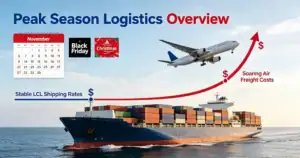
Between August and October, air freight rates often double (or more) as sellers rush to prepare for Black Friday and Christmas. LCL rates are much more stable. If you’re selling holiday-specific items, shipping them via LCL 2–3 months ahead of time is a cost-saving move.
✅ Scenario 6: Your shipment is between 1 and 15 CBM
A rule of thumb:
-
Under 1 CBM – Many forwarders won’t take it, or they charge a high minimum fee. Use courier or air instead.
-
1–15 CBM – The sweet spot for LCL. Much cheaper than air, much easier than FCL.
-
Over 15 CBM – Compare LCL and FCL pricing. Sometimes a full container has a lower per-CBM rate, even if you don’t fill it completely.
| Volume Range | Recommended Method | Reason |
|---|---|---|
| < 1 CBM | Courier / Air freight | LCL minimum fees make it uneconomical |
| 1–15 CBM | LCL | Best balance of cost and flexibility |
| > 15 CBM | FCL | Lower per-CBM rate, no consolidation delay risk |
❌ When should you not use LCL?
Knowing when to avoid LCL is just as important:
-
Urgent restocks (only a few days of FBA stock left) – You need air or courier, or you’ll run out.
-
High-value, small items (electronics, jewelry) – The extra air freight cost is covered by high margins, and faster delivery helps cash flow.
-
You can actually fill a container – If you have close to 28 CBM, just take a full container.
-
Time‑sensitive products (holiday decorations, seasonal food) – A possible LCL delay could make you miss the selling window.

4. What to watch for when choosing an LCL freight forwarder
When you decide to go with LCL, picking the right logistics partner matters more than just finding the lowest price.
1) Ask about destination charges
Some quotes look cheap because they only show the China side, while destination fees are a surprise. Ask for a full breakdown including:
-
China side: trucking, document fees, customs clearance, consolidation fee.
-
US side: deconsolidation, port fees, customs clearance (if not included), delivery to FBA.
2) Confirm the minimum charge
Most LCL services charge a minimum of 1 CBM. If you have only 0.6 CBM, you still pay for 1. A few forwarders offer 0.5 CBM minimums, but the rate per CBM is usually higher.
3) Understand the delay risk
Ask your forwarder: “What happens if someone else’s cargo in the same container gets inspected? How will that affect my delivery time?” A pro forwarder will be upfront about the risk and may have backup plans (like splitting containers in some cases).
4) Ask for tracking capabilities
Ocean freight doesn’t track like a courier, but a decent forwarder can give you the vessel name, voyage number, container number, and a deconsolidation notification so you can check progress online or via customer service.
ABout AMZ Shipper
AMZ Shipper has several years of experience for international logistics Freight Forwarding service. Our service is for importer and exporter, foreign freight forwarders, local and abroad business. Export of 1500 of 40HQ per year for FBA Amazon shipping, 15-30tons of air shipments per month.
Member of WCA. Our company is a professional Amazon freight forwarder that specializes in providing comprehensive and efficient services to customers.