If you are an Amazon seller and source products from China, you already know how much work goes into managing your supply chain. You worry about running out of stock, but you also don’t want to over-order and get hit with long-term storage fees. This is where AI comes in. It can help you predict demand, book shipments, and track problems automatically. In this article, we’ll walk through six areas where AI can actually help Amazon sellers automate their supply chain, and why you still need a real logistics partner (like AMZ Shipper) to make it work.
1. What Does Supply Chain Automation Really Mean for Amazon Sellers?
In simple terms, supply chain automation means letting a system handle repetitive decisions and tasks instead of doing them manually. For Amazon sellers, an automated process might look like this:
-
The system checks your average daily sales from the last 30 days, seasonal trends, and upcoming promotions
-
An AI model calculates when and how much you should reorder
-
It creates a shipment order from your warehouse in China to an Amazon FBA center
-
It compares shipping options (sea or air) from different carriers and picks the best one
-
It tracks the shipment and updates the estimated arrival time automatically if there’s a delay
For most small and medium sellers, doing all of this by hand is time-consuming and easy to mess up. This is especially true if you have multiple SKUs and send to different Amazon warehouses (like in California, Texas, or Pennsylvania). AI doesn’t rely on gut feelings—it uses historical data and real-time signals to make smarter decisions.
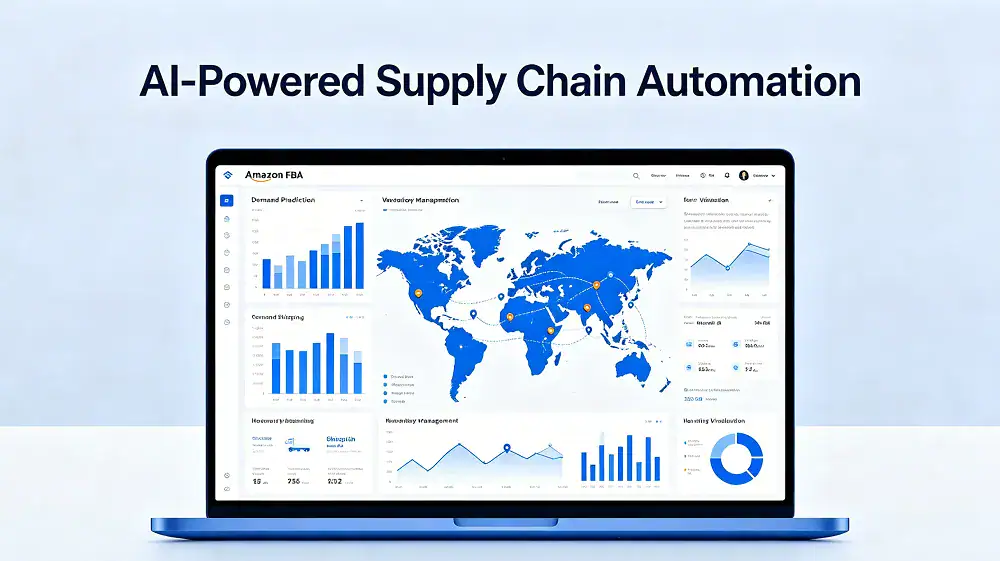
2. Three Key Areas Where AI Automates Your FBA Workflow
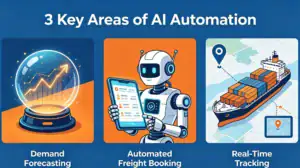
Based on our experience at AMZ Shipper working with Amazon sellers who ship from China, AI really shines in three specific areas.
2.1 Demand Forecasting and Inventory Planning
AI can look at your sales history, seasonal patterns, competitor prices, and even weather data to suggest how much you should reorder for each ASIN, usually 4 to 8 weeks ahead. This is way more accurate than the old “average daily sales times shipping days” method. AI can also spot unusual spikes—for example, a one-time sales jump from a deal site—and decide whether to treat it as normal going forward or ignore it.
2.2 Automated Freight Booking and Rate Comparison
Once you know how much to ship and when it needs to arrive, AI can connect to multiple carriers’ systems and get real-time rates. It checks options from your warehouse in China (say, Shenzhen, Ningbo, or Qingdao) to specific FBA depots like ONT8 or FTW1. Then it recommends the best balance of speed and cost, and can even book the shipment for you.
2.3 Real-Time Tracking and Exception Handling
After your shipment leaves, AI keeps an eye on the vessel’s location, customs status, and truck appointments. If it sees a possible delay (like a port closure due to a storm or a labor strike), it recalculates the new arrival date and can suggest a backup plan—for example, splitting the order and sending part by air to avoid a complete stockout.
| Step | Common Manual Problems | How AI Helps |
|---|---|---|
| Demand forecast | Misses seasonal trends, leads to overstock or shortages | Uses 10+ dynamic factors, gives probability-based predictions |
| Rate & carrier comparison | Takes half a day to check 2–3 carriers, info is often outdated | Scans live rates, delivers a bookable plan within 10 minutes |
| Exception handling | You find out about delays too late to fix them | Warns you early and suggests alternative routes or modes |
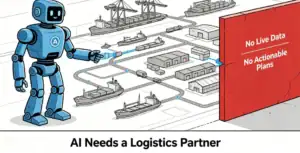
3. Why Off-the-Shelf AI Tools Won’t Work for Amazon Supply Chains Alone
You might already use ChatGPT or Claude to write product listings or reply to emails, but you can’t really use them to manage FBA replenishment. Here’s why:
-
They don’t have live logistics data. They don’t know which US West Coast port is backed up today, or which carrier has been late lately.
-
They can’t book shipments for you. An AI can say “book a 40HQ from Yantian to Long Beach,” but it can’t actually get a shipping order, book a truck, or arrange pickup from your supplier.
-
They don’t understand Amazon’s internal rules. Amazon sometimes restricts how much a warehouse can receive. You need to know which FBA depot is less busy right now, and a general AI has no clue about that.
In other words, AI needs to be connected to real logistics networks and Amazon data to produce an actionable shipment plan, not just a nice blog post. That’s exactly where a logistics company adds value: turning AI’s recommendations into an actual bill of lading.
4. How to Start Using AI for Your Amazon Supply Chain (A Simple 3-Step Plan)
You don’t need to buy an expensive enterprise system all at once. Here’s a practical way to get started.
-
Pick an inventory tool with an API
Tools like RestockPro, Forecastly, or SellerLegend already have basic AI forecasting built in. You just grant them access to your Amazon orders, set your target inventory days (say, 30 days), and they’ll give you suggested restock quantities. -
Connect the tool to your logistics partner
This is the key step. You need a logistics provider like AMZ Shipper that can take your restock list (via CSV or API) and automatically figure out the best way to ship from your Chinese warehouse to your FBA depots. In an ideal setup, the system sees “ASIN A needs 500 units and must arrive at FTW1 in 4 weeks,” and then generates a full or LCL booking. -
Set up rules for automatic exception handling
Define a few simple scenarios. For example: “If a shipment is delayed by more than 3 days and we have less than 2 weeks left, automatically shift 20% of the volume to air freight.” This way, AI can help keep your inventory balanced without you checking every single shipment.
Here’s a simple example of how the logic might work:
| Trigger Condition | AI Decision | Action Taken |
|---|---|---|
| An ASIN has only 10 days of stock left based on forecast | Reorder 800 units | Reserve stock at your China warehouse, create shipment request |
| The preferred FBA warehouse is currently congested | Send to another nearby warehouse with normal receiving | Update the destination ID in the shipment plan |
| 25 days until the final delivery deadline | Choose ocean freight (standard speed) to save cost | Send booking order to freight forwarder, allocate container |
5. Real-World Results from Sellers Who Tried This
Based on feedback from Amazon sellers who work with AMZ Shipper and started using AI-assisted supply chain automation (usually after 3 to 6 months), here are some common improvements:
-
Stockout rate dropped from over 10% to below 3%
-
Emergency air shipments were reduced by about two-thirds
-
Hidden costs like amendment fees, demurrage, and storage overcharges went down noticeably per container
-
Operations staff saved roughly 8 to 10 hours per week on logistics follow-up
It’s worth noting that none of these results required an ultra-expensive “cutting-edge” AI system. As long as you close the loop between sales forecast → automated restock calculation → logistics execution, most FBA sellers shipping from China can see meaningful efficiency gains.

6. Quick FAQs for Amazon Sellers
Q: I’m a small seller with only 20 active SKUs and unstable monthly sales. Do I really need AI?
A: Yes, but focus on your 5 to 10 best-selling ASINs that bring most of your profit. You don’t need an expensive enterprise system. Many lightweight inventory tools have monthly subscriptions and built-in basic AI forecasting. Once you automate your core SKUs, you’ll notice the difference in stockout rates pretty quickly.
Q: Will AI automation completely replace my logistics team?
A: No. AI is good at repetitive calculations, pattern recognition, and automated triggers. But exceptions still need people. For example, if your supplier is delayed by two weeks, or Amazon suddenly changes a warehouse’s appointment rules, you’ll want a real person to step in. The best model is “AI handles the routine, people handle the unusual.”
Q: Does AMZ Shipper provide AI tools, or just execute the bookings generated by AI?
A: Our main job is to turn AI predictions into real shipping solutions. You can use your own inventory tool and share the replenishment suggestions with us. We then use our own route optimization (which includes live carrier data and port congestion updates) to recommend the best shipping plan. At the same time, we keep human customer support—so if you’re unsure about an AI recommendation, you can talk to someone who can explain and adjust it. That way, you get the efficiency of AI and the personalized service we promise on our site.
Q: My suppliers are in different cities (like Yiwu and Guangzhou). Can AI automatically decide which warehouse to ship from?
A: Yes. A slightly more advanced AI module can factor in inventory levels at each supplier, trucking cost and time to the nearest port, and production status. For example, even though Guangzhou is closer to Yantian port, if Yiwu has finished goods ready to go but Guangzhou is still producing, the system might suggest shipping from Yiwu first to avoid waiting. This kind of logic can be built into your automation rules fairly easily.
ABout AMZ Shipper
AMZ Shipper has several years of experience for international logistics Freight Forwarding service. Our service is for importer and exporter, foreign freight forwarders, local and abroad business. Export of 1500 of 40HQ per year for FBA Amazon shipping, 15-30tons of air shipments per month.
Member of WCA. Our company is a professional Amazon freight forwarder that specializes in providing comprehensive and efficient services to customers.