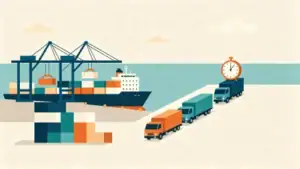
The ocean freight market in 2026 has been a real eye‑opener for cross‑border sellers – ocean freight rates are never something you can take for granted. As of July 3, 2026, the Shanghai Containerized Freight Index (SCFI) closed at 3,326.87 points, up 77.4% from its yearly low of 1,875.26 on April 24. That marked ten consecutive weeks of gains and hit a four‑year high. The US West Coast route saw weekly jumps of over 10% multiple times, while the Europe base port rate surged 22.7% in a single month.
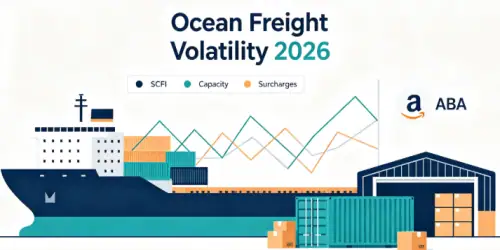
But what really matters is not just the rise – it’s the frequency and amplitude of the swings. This isn’t a one‑off spike on a few routes; it reflects a structural adjustment in global container shipping as supply and demand rebalance. For Amazon FBA sellers, understanding the logic behind these ocean freight rate movements is far more useful than trying to guess the next up or down.
Rate Volatility Is the New Normal
Freight rate swings are no longer a short‑term phenomenon – they are becoming a lasting feature of the shipping market.
According to the China Shipping Prosperity Index Report for Q2 2026, released by the Shanghai International Shipping Institute, 72.73% of container carrier respondents cited route diversions caused by waterway risks, along with rising fuel, insurance, war‑risk and peak‑season surcharges, as the top driver of market volatility. In other words, more than seven out of ten shipping companies attribute the current turbulence to waterway risks and the cost increases that follow.
At the same time, the shipping industry is shifting from “efficiency‑first” to “resilience‑first” – nearly 70% of carriers say that comprehensive supply‑chain risk early‑warning systems have become the service feature most requested by their customers.
The old concept of a fixed “peak season” is outdated. In 2026, the cargo rush arrived significantly earlier than it did before the pandemic. The US tariff changes on July 24 triggered a wave of front‑loading, and combined with Amazon Prime Day inventory build‑ups, transpacific volumes surged in a very short window. Sellers can no longer rely on old calendar rules like “from month X to month Y is the busy season” to predict rate moves.
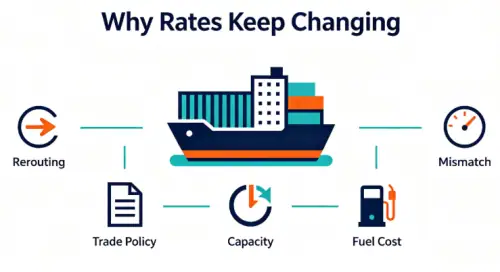
What’s Driving the Constant Changes in Ocean Freight Rates?
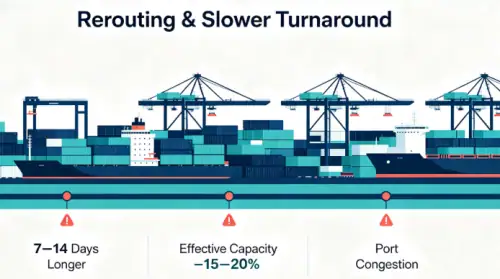
1. Route Diversions and Slower Turnaround
Route disruptions hit the shipping market in two ways: they break the normal flow of services and reshape global supply chains, while also pushing up fuel and insurance costs significantly.
Most vessels are now taking the longer Cape of Good Hope route, adding 7 to 14 days to each one‑way voyage. That effectively takes 15% to 20% of active capacity out of the market. Longer voyages not only increase the per‑container shipping cost but also slow down vessel turnaround, making available space even tighter.
2. Trade Policy and “Front‑Loading” Waves
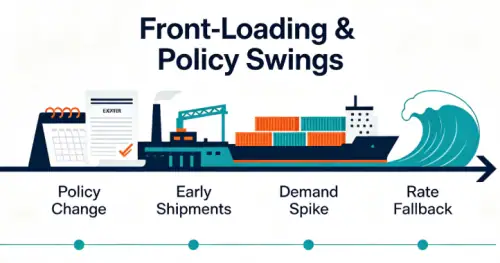
Frequent tariff changes often spark rush‑shipment waves – exporters ship as much as possible before new policies take effect, pushing freight rates up in the short term. In 2026, for example, the pre‑deadline rush ahead of US interim tariff expirations was a key force behind the sustained rise on the transpacific routes.
But once those front‑loading waves end, demand can drop off sharply, and ocean freight rates tend to correct. These policy‑driven swings are hard to predict, adding a big dose of uncertainty to Amazon sellers’ inventory planning.
3. Carriers’ Active Capacity Management
Shipping lines are tightening supply through blank sailings, slow steaming, and capacity cuts. With new vessel deliveries still limited in 2026 – global fleet growth is expected at only 3.7% to 4.5% for the year – the major alliances are simultaneously reducing available slots.
At the same time, over‑booking is widespread. Shippers book multiple slots and then cancel the extras, releasing a large number of idle spaces back to the market, which adds even more volatility to spot ocean freight rates.
4. Fuel Costs and Environmental Compliance Costs
Bunker fuel is a core operating cost, so its price fluctuations directly affect ocean freight rates. Geopolitical tensions have driven fuel costs noticeably higher.
More importantly, environmental compliance is adding a structural cost layer. From January 1, 2026, the EU Emissions Trading System (EU ETS) entered its full compliance phase – shipping companies must now report 100% of their emissions, up from 70% in 2025. That has materially raised the carbon‑compliance cost per unit of fuel on European routes. Frequent adjustments of surcharges (like the BAF, PSS, and others) make the final “landed” rate hard for Amazon sellers to estimate in advance.
5. Structural Supply‑Demand Mismatch
Global fleet capacity and trade demand remain out of sync in 2026. But “nominal capacity” is not the same as “effective capacity” – diversions, port congestion, and other factors keep eating into the space that’s actually usable. Average waiting times at Northern European ports still hover around 1.5 to 2 days, and yard utilisation at Mediterranean ports remains high.
The combination of tightening supply and concentrated demand spikes means ocean freight rates can swing rapidly between “oversupply” and “space crunch”.
The table below summarises the five core drivers and their main impacts on Amazon sellers:
| Driver | Core Mechanism | Impact on Amazon Sellers |
|---|---|---|
| Route diversions & slower turnaround | +7–14 days per voyage, 15–20% effective capacity loss | Tighter space, more schedule uncertainty |
| Trade policy & front‑loading | Policy deadlines trigger demand surges | Hard to time replenishment windows |
| Carriers’ capacity management | Blank sailings & slow steaming actively reduce supply | Spot rates become more volatile |
| Fuel & environmental compliance | Higher fuel cost + carbon cost | Frequent surcharge changes, hard to forecast final rate |
| Structural supply‑demand mismatch | Nominal ≠ effective capacity | Rates flip quickly between tight and loose |
How Does Ocean Freight Volatility Hurt Amazon Sellers?
Unpredictable costs. The same shipment can get you completely different quotes just a week apart. Many Amazon sellers focus only on the unit price, ignoring how often and how much rates can move – a rate locked in today might be obsolete tomorrow.
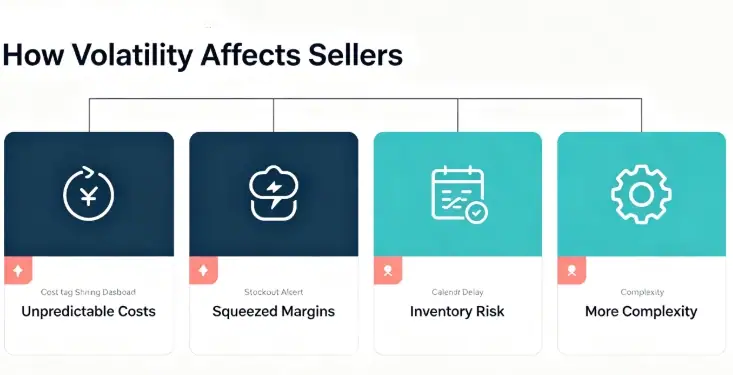
Direct margin pressure. For low‑value products, rising ocean freight rates can eat into profits dramatically. In 2026, first‑leg shipping costs went up by 25% to 30%, and for some categories, gross margins shrank by more than 40%.
Higher inventory risk. Rate hikes often come with tighter space and a greater chance of rolling. One Ningbo‑based seller of home appliances on Amazon ran into exactly that – his cargo arrived at the terminal but didn’t make it onto the vessel, messing up his restocking schedule and putting his best‑seller at risk of stock‑outs.
More complex decision‑making. Amazon sellers already have to juggle product selection, operations, and advertising – now they also have to keep an eye on shipping market dynamics thousands of miles away. When transpacific space is tight and rolling becomes routine, that information directly affects replenishment decisions.
What Amazon Sellers Can Do to Cope with Ocean Freight Rate Swings
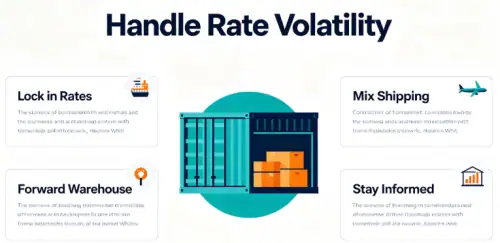
Lock in rates early. Sign quarterly or peak‑season fixed‑rate contracts 2 to 3 months before the busy season. Choose logistics partners that have long‑term contracts with carriers – they tend to have better cost bases and more stable quotes.
Mix your shipping options. Use faster vessels or air freight for hot‑selling items to secure timeliness, and opt for slower (and cheaper) ocean services for regular products. Adopt a “sea freight base + warehouse buffer” strategy: send bulk inventory to an overseas warehouse well ahead of time, then top up FBA from that local warehouse as needed.
Build a forward inventory buffer. Move most of your stock into an overseas warehouse 2 to 3 months in advance, keeping only short‑term safety stock at FBA. During peak periods, make smaller, more frequent transfers from the overseas warehouse to FBA, avoiding the most expensive shipping windows.
Watch the trend, not the daily noise. Follow the general direction of indices like the SCFI rather than fretting over weekly moves. Stay in close touch with your logistics partner to get timely updates on space and rate conditions. Accept that volatility is here to stay – focus on managing expectations rather than trying to predict exact numbers.
Ocean freight rate swings are not going away – route risks, trade policies, environmental regulations, and capacity cycles will keep interacting in complex ways. For Amazon sellers, the real challenge is not about forecasting the next hike, but building a logistics system that can absorb the shocks.
As a logistics provider focused on cross‑border ocean shipping for e‑commerce, AMZ Shipper keeps a close watch on market developments and helps Amazon sellers find the right shipping solutions in this ever‑changing ocean freight environment.
ABout AMZ Shipper
AMZ Shipper has several years of experience for international logistics Freight Forwarding service. Our service is for importer and exporter, foreign freight forwarders, local and abroad business. Export of 1500 of 40HQ per year for FBA Amazon shipping, 15-30tons of air shipments per month.
Member of WCA. Our company is a professional Amazon freight forwarder that specializes in providing comprehensive and efficient services to customers.