When it comes to FBA headhaul logistics, choosing the right trade term (Incoterm) can make or break your shipment. Two options you’ll often come across are DDP (Delivered Duty Paid) and DDU (Delivered Duty Unpaid). But they’re not just a matter of picking the cheaper quote — how they work, who takes on what responsibility, and where the risks lie are completely different stories.
For Amazon sellers, picking the wrong one could lead to your shipment being turned away at the warehouse, unexpected storage fees piling up at the port, or even your account performance taking a hit. This article breaks down the key differences between these two shipping modes, looks at what Amazon’s FBA program actually requires, and gives you a clear framework for making the right call.
1. What Exactly Are DDP and DDU?
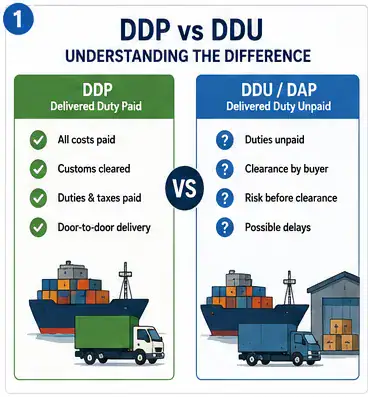
These two terms are part of the international trade rules (Incoterms) that define who handles what — from shipping costs and customs clearance to risk and title transfer.
DDP (Delivered Duty Paid) means the seller takes on all the risks and costs involved in moving the goods to the buyer’s specified destination. That covers international freight, export customs clearance, import customs clearance at the destination country, and paying the import duties and VAT/GST along the way. For Amazon sellers, this is essentially a “door-to-door, duties-paid” service. By the time your shipment reaches the FBA warehouse, all customs formalities have been handled, and the goods are ready to be checked in.
DDU (Delivered Duty Unpaid) means the seller is responsible for getting the goods to the destination country, but stops short of handling import clearance or paying the duties and taxes over there. Those tasks fall on the buyer (the consignee). One important note: in the latest version of the Incoterms rules, DDU has technically been replaced by DAP (Delivered at Place). But in day-to-day logistics conversations, people still use “DDU” to refer to this type of arrangement.
The real difference comes down to one simple question: who takes care of import customs clearance and pays the duties?
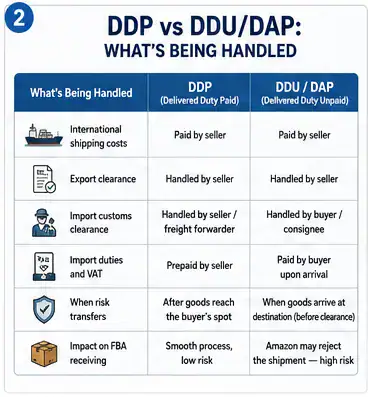
| What’s Being Handled | DDP (Delivered Duty Paid) | DDU / DAP (Delivered Duty Unpaid) |
|---|---|---|
| International shipping costs | Paid by seller | Paid by seller |
| Export clearance | Handled by seller | Handled by seller |
| Import customs clearance | Handled by seller / freight forwarder | Handled by buyer / consignee |
| Import duties and VAT | Prepaid by seller | Paid by buyer upon arrival |
| When risk transfers | After goods reach the buyer’s spot | When goods arrive at destination (before clearance) |
| Impact on FBA receiving | Smooth process, low risk | Amazon may reject the shipment — high risk |
2. Amazon’s FBA Rule: Why DDU Is a Big Gamble
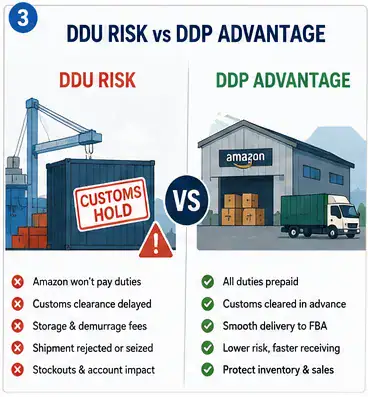
Here’s something every Amazon seller needs to understand: Amazon will not act as the “Importer of Record” for your FBA inventory, and they will not pay customs duties or clearance fees on your behalf.
What does that mean in practice? If you ship under DDU terms, your goods will arrive at the destination port, but Amazon (as the “consignee”) won’t step in to clear customs or hand over any money for duties. Your shipment will just sit at customs, racking up storage and demurrage charges by the day. In a worst-case scenario, it could even be seized or destroyed. On top of losing your inventory, you might also face stockouts that hurt your listing ranking and sales.
Amazon’s official guidelines and forum discussions are pretty clear on this point: “Amazon warehouses will not accept cartons that require payment on receipt.” Many logistics platforms also explicitly state that “All Amazon orders must be delivered DDP” when you’re setting up international shipping options.
For this reason, using DDP for FBA shipments is essentially a non-negotiable requirement. Experienced FBA logistics providers will always recommend DDP, and they’ll act as your import agent to handle clearance and duty prepayment on your behalf.
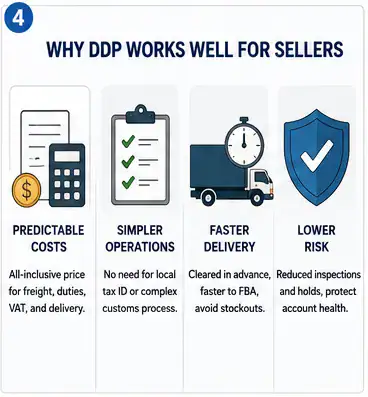
3. Why DDP Works Well for Sellers: Control, Simplicity, and Safety
Choosing DDP means you’re handing over the complicated parts — customs clearance, duty calculations, and tax compliance — to a professional logistics partner. That brings several clear benefits.
Predictable costs, stable margins
DDP gives you an all-inclusive price that covers everything: ocean or air freight, clearance fees, duties, VAT, and final-mile delivery. With that number in hand, you can calculate your exact “landed cost” per unit and price your products with confidence. With DDU, on the other hand, the quote you get usually only covers the basic freight — you won’t know the final bill until the goods arrive, which makes it hard to protect your margins.
Simpler operations, lower barriers
With DDP, you don’t need to register for a local tax ID (like an EIN in the US or VAT/EORI in Europe) or handle complicated customs documents yourself. That’s a huge advantage, especially for smaller sellers or those just getting started. Your freight forwarder takes care of everything — from preparing the paperwork to prepaying the duties.
Faster delivery to FBA, fewer operational hiccups
Since DDP shipments are already cleared by the time they reach the destination port, they can move quickly to the FBA warehouse. That helps you avoid stockouts caused by customs delays. Plus, proper DDP clearance reduces the chance of your shipment being flagged for inspection or held up, which protects your inventory performance and account health.
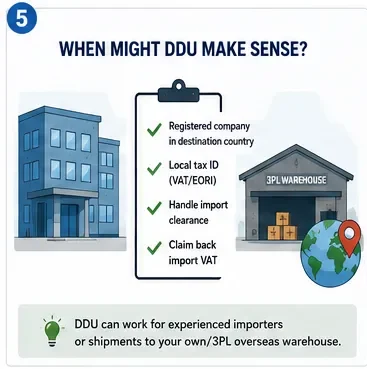
4. When Might DDU Make Sense?
Even though DDP is the go-to choice for most Amazon sellers, DDU (or DAP) isn’t completely useless. There are a few situations where it can work — but they’re pretty specific.
If you have a registered company in the destination country, hold a local tax ID (like a VAT number or EORI), and have the capability to handle import clearance yourself, then DDU could give you more control over the process. This is especially relevant if you need to claim back import VAT as part of your tax filing.
DDU can also be a viable option for shipments going to your own overseas warehouse or a third-party warehouse, provided the receiving party there has the proper customs clearance setup.
But for the vast majority of Amazon FBA sellers — especially those shipping from China — DDU is far more trouble than it’s worth. We strongly advise against it.
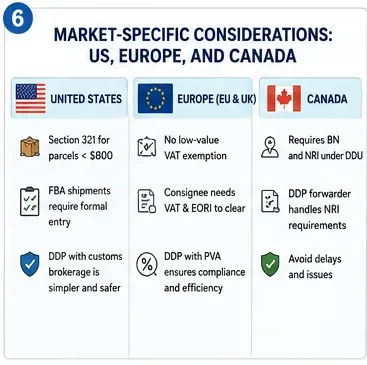
5. Market-Specific Considerations: US, Europe, and Canada
Different countries have different customs rules and tax systems, which can affect how DDP and DDU play out in practice. Here’s a quick look at the major markets.
United States: DDP is the standard
The US is the biggest market for most Amazon sellers. While there’s a “Section 321” rule that allows duty-free entry for shipments under $800, that mainly applies to small parcels sent via direct mail. For FBA shipments — which are typically larger and sent in bulk — you’ll need to go through formal entry procedures, which may require a Customs Bond. Going with DDP, where your freight forwarder handles the customs brokerage and duty payment, is the simpler and safer route.
Europe (EU and UK): DDP is non-negotiable
Europe has some of the strictest tax rules. Since the VAT reform in 2021, all imported goods are subject to VAT — the low-value exemption is gone. If you try to ship DDU to Europe, your goods will need the consignee (Amazon) to step in with a local VAT and EORI number to clear customs. But we already know Amazon won’t do that. So DDP is your only real option here. Many forwarders also use mechanisms like Postponed VAT Accounting (PVA) to keep things compliant and efficient.
Canada: Handle the NRI situation carefully
Shipping to Canada comes with its own tax complexities. Under DDU terms, the consignee would need a Canadian Business Number (BN) and a Non-Resident Importer (NRI) account to clear the goods. Without those, you’re looking at delays. A good DDP service provider can help you navigate the NRI requirements so the process stays on track.
6. How DDP vs. DDU Works in Seller Central
One thing that often confuses sellers: there’s no button inside Seller Central where you choose “DDP” or “DDU.” This is something you work out with your freight forwarder, not with Amazon directly.
Here’s how the process usually goes:
-
Choose your shipping method: In Seller Central, you select either “Amazon Partnered Carrier” (like AGL) or “Non-Amazon Partnered Carrier” — which is what most Chinese sellers use. If you go with the latter, that’s when you start talking terms with your forwarder.
-
Agree on the trade terms with your forwarder: You’ll specify in your shipping contract or quotation whether you’re shipping under DDP or DDU. This is a commercial agreement between you and the logistics provider.
-
Prepare customs paperwork:
-
Under DDP: Your forwarder will guide you on the commercial invoice, packing list, and other required documents. They (or their overseas agent) will act as the Importer of Record and prepay the duties. The invoice usually clearly states “DDP.”
-
Under DDU: In theory, the consignee (Amazon) would handle clearance — but as we’ve discussed, that’s not workable and almost always fails.
-
-
A critical reminder: When filling out the shipping address and destination warehouse address in Seller Central, do not put “Amazon” as the consignee name. Instead, use “Amazon Fulfillment Services” or the standardized FBA receiving address provided by your forwarder. Amazon doesn’t play any role in the customs clearance stage.
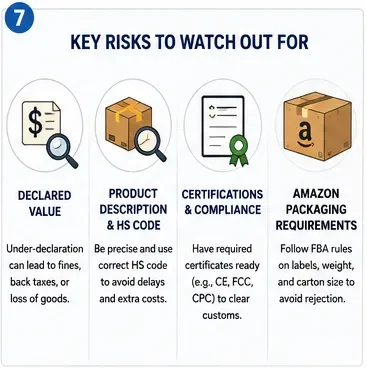
7. Key Risks to Watch Out For in Customs Clearance and Declaration
No matter which shipping mode you choose, making sure your customs declaration is accurate and compliant is essential for smooth delivery. Here are some risks that deserve extra attention:
Declared value
Customs authorities review declared values closely. Under-declaring is a high-risk move — if you get caught, you could face fines, back taxes, or even lose your goods. A safer approach is to declare a reasonable value based on your actual purchase cost plus freight and other fees. Always keep it truthful and compliant.
Product description and HS code
You need to be precise with your product description. Being vague — like saying “garments” instead of “100% cotton women’s knitted T-shirt” — can significantly increase your chances of being flagged for inspection. And don’t forget the HS code: getting it right is key, because it directly affects your duty rate and any regulatory requirements.
Certifications and product compliance
Some products require specific certificates to clear customs — for instance, FCC or CE certifications for electronics, or CPC for children’s products. These documents need to be ready and included with your shipment. Even if your declared value is correct, missing certifications can get your cargo held up.
Amazon’s packaging requirements
Amazon has strict rules on how FBA shipments should be packed — things like FNSKU label placement, box weight limits, and carton size specifications. When you use DDP, a good freight forwarder will often do “upstream prep” before shipping, helping you label, pack, and palletize everything to meet Amazon’s receiving standards. That way, you’re less likely to run into trouble at the warehouse door.
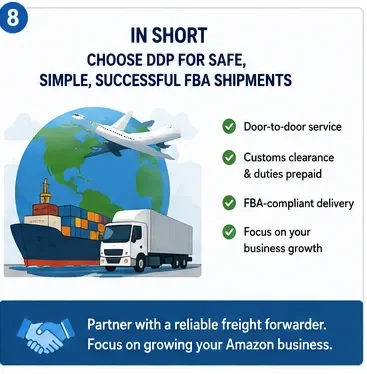
In short, picking between DDP and DDU for your Amazon shipments isn’t just a cost comparison — it’s a strategic choice that affects your business safety, operational efficiency, and long-term growth. Given Amazon’s FBA rules and the real-world risks in cross-border shipping, for the vast majority of FBA shipments, DDP is the most reliable and hassle-free option.
At AMZ Shipper, we specialize in FBA headhaul logistics and have years of hands-on experience in the industry. We’re a WCA member and offer DDP ocean and air freight services from China to the US, Europe, the UK, Canada, Australia, and beyond. Our team handles the entire process — from pick-up at your supplier, export customs, international shipping, import clearance and duty prepayment, all the way to final delivery at the FBA warehouse. That way, you can stay focused on your product listings, marketing, and sales growth.
If you’d like to learn more about our DDP services or get a customized shipping plan for your business, feel free to reach out to the AMZ Shipper team — we’re here to help.